Laser metal deposition of hydraulic cylinders and piston rods
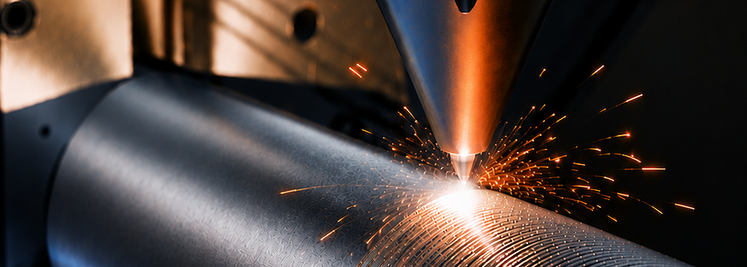
Piston rods and hydraulic cylinders are exposed to extreme mechanical and corrosive stresses. Conventional surface protection methods are increasingly reaching their regulatory and technical limits. Laser metal deposition – also known as laser deposition or laser surfacing – is establishing itself as a future-proof manufacturing technology that outperforms conventional methods such as hard chrome plating and thermal spraying in key performance parameters. EMAG LaserTec develops and builds turnkey production systems thatbring this process to industrial-scale, cost-effective batch production for the first time.
For which applications is laser metal deposition suitable?
Laser metal deposition of hydraulic cylinders and piston rods addresses a wide range of industries and applications. The process demonstrates its strengths wherever high mechanical loads, corrosive environments, and long service life are required.
01.
Hydraulic cylinders in mechanical engineering and mobile hydraulics
Mobile cranes, construction machinery, agricultural machinery, and mining equipment subject hydraulic cylinders to the harshest conditions. Dust, moisture, temperature fluctuations, and high pressures continuously stress the piston rod surface. Laser-coated piston rods offer measurably longer service life in these applications and reduce unplanned downtime.
02.
Axial piston units and pump components
Pistons in axial piston pumps and motors are subjected to high sliding speeds and surface pressures. Laser metal deposition creates surfaces with low friction and high load-bearing capacity, which minimize wear and extend the service life of the entire hydraulic unit.
03.
Chromium(VI)-free manufacturing
Laser metal deposition operates entirely without electroplating processes and thus without chromium(VI) compounds. Manufacturers who rely on this process meet the requirements of the REACH Regulation and simultaneously position themselves as forward-thinking partners to their customers.
What machine concepts does EMAG offer for the laser metal deposition of piston rods?
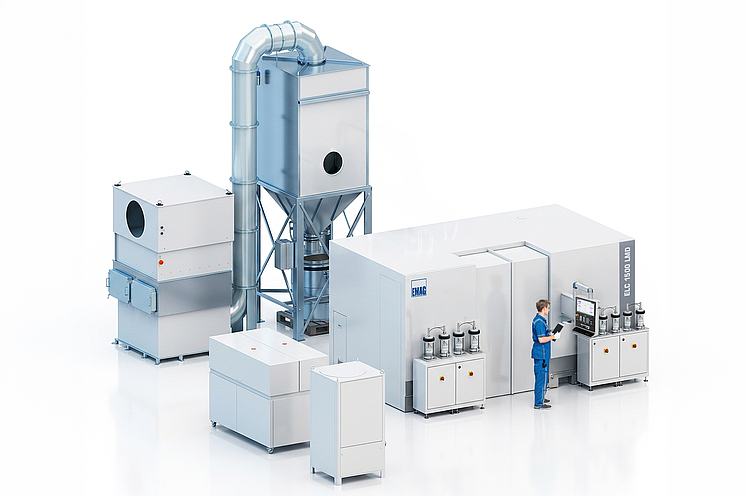
ELC 1500 LMD and ELC 2700 LMD – shaft coating up to 2.7 meters
The EMAG laser cladding systems of the ELC LMD series are specifically designed for coating rotationally symmetrical components. The system consists of a spindle head with drive, an electric tailstock, and a positioning system for the process optics with powder or wire feed.
Key technical data for the ELC LMD series:
| Parameters | ELC 1500 LMD | ELC 2700 LMD |
|---|---|---|
| Max. workpiece length | 1,500 mm | 2,700 mm |
| Max. workpiece dia. | 1,000 mm | 1,000 mm |
| Max. workpiece weight | 2,000 kg | 2,000 kg |
| Filler material | Powder or wire | Powder or wire |
The systems feature integrated sensory equipment for process monitoring, which has proven itself repeatedly in the highly demanding, safety-critical coating processes for brake discs. The powder conveyor, laser source, cooling unit, and extraction system are integrated into the machine concept as a complete package.
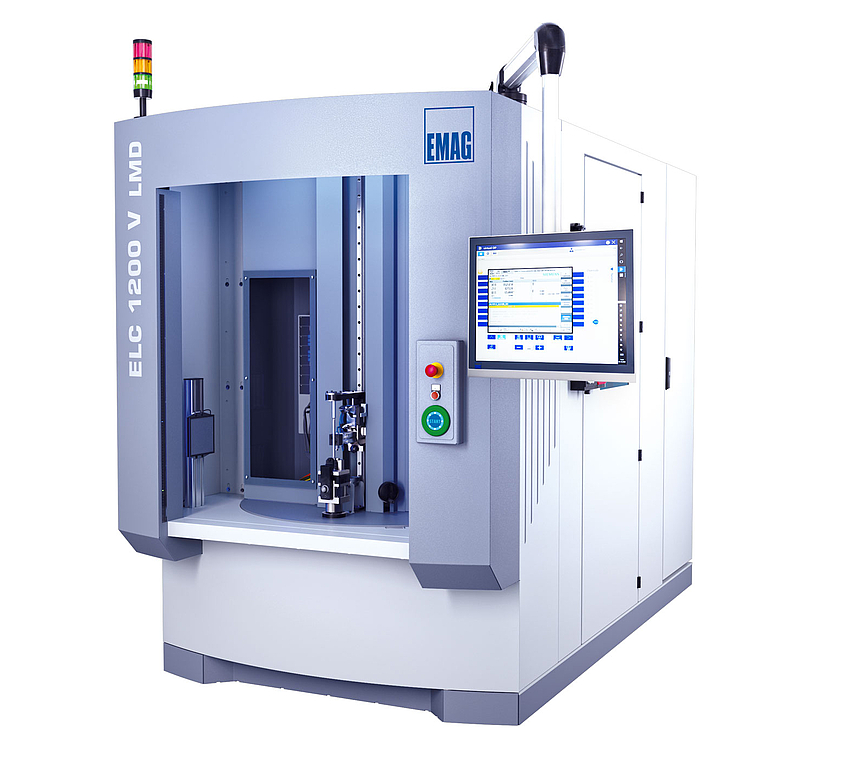
ELC 1200 V LMD – Compact system for small parts and series production
For smaller components such as axial pistons, discs, or wear parts, EMAG offers the ELC 1200 V LMD. This compact vertical machine is based on the proven ELC 1200 V platform, equipped with a rotary table and a special workpiece holder, and can be individually automated. For small parts, multiple holders as well as unmanned robotic loading and unloading or gantries can be used. For example, a vibratory conveyor feeds the workpieces, and a handling robot automatically loads the machine. After the coating process, the components are discharged via gravity roller conveyors. This solution enables cost-effective batch production even at high volumes.
How does EMAG support the transition to laser metal deposition?
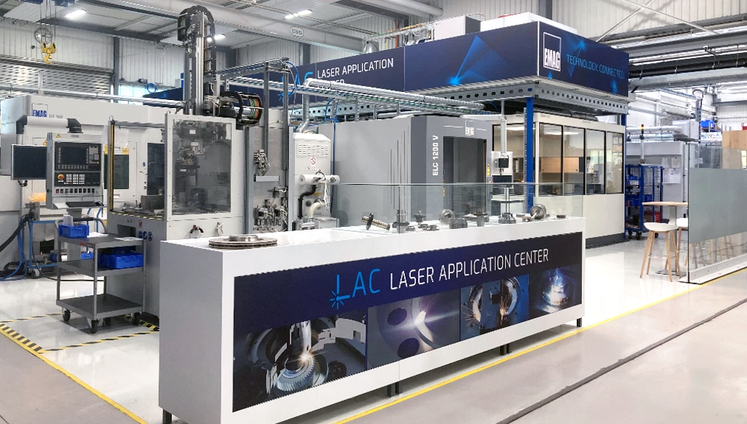
EMAG supports the entire process from the initial feasibility analysis to the turnkey production system. Application-specific coating trials are conducted at the company’s in-house technology center to validate material selection, process parameters, and coating properties.
By combining laser technology, mechanical engineering, and automation expertise under one roof, EMAG offers turnkey total solutions. This turnkey approach shortens project duration and reduces interface risks that arise when multiple suppliers collaborate.
Frequently Asked Questions About Laser Metal Deposition of Piston Rods & Hydraulic Cylinders
- Can laser metal deposition completely replace hard chrome plating?
- What materials can be used as coating materials?
- What surface quality is achieved after laser metal deposition?
- Is discoloration of the coating possible?
- What component sizes are EMAG laser cladding systems designed for?
Yes, in numerous applications, laser metal deposition offers a technically superior and future-proof alternative to hard chrome plating. The metallurgical bond, the absence of chromium(VI), and the superior corrosion resistance under dynamic loading clearly support the switch to this technology.
EMAG processes a wide range of metal powders and wires. Typical coating materials include chromium-carbide-containing alloys, nickel-based alloys, and cobalt-based alloys. The choice of material depends on the requirements for hardness, corrosion resistance, and friction behavior of the specific application.
The laser-coated surface is subjected to grinding following the coating process to achieve the required final diameter and necessary surface quality for sealing operation. Surface roughness values of +/- 15 µm are achievable.
Under certain operating conditions, the surface of a laser-coated piston rod may become discolored. This discoloration has no effect on the technical functionality, corrosion resistance, or wear properties of the coating.
The ELC LMD series processes workpieces up to 2,700 mm in length, 1,000 mm in diameter, and 2,000 kg in weight. Larger dimensions are available upon request. The compact ELC 1200 V LMD is available for small parts and series production.
Advantages
- Turnkey production systems from a single source – machine, laser, automation, and process technology
- Proven sensory equipment and process monitoring from large-scale production
- Flexible machine platforms for components ranging from a few centimeters to 2.7 meters in length
- Powder and wire processes depending on application requirements
- Global service and support network for ongoing operations
Machines
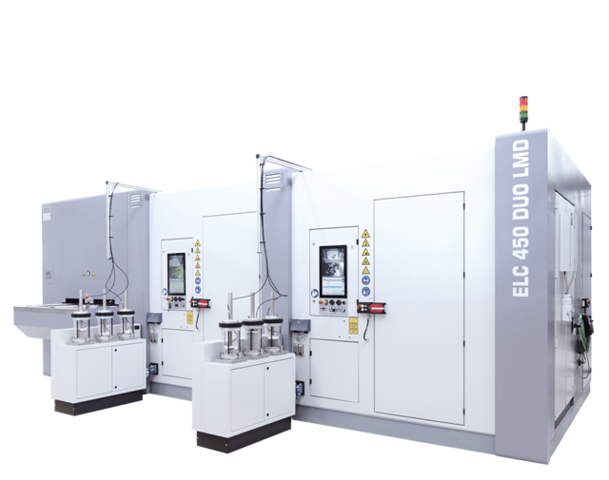
(1) machines found

Technologies
Complex Manufacturing Systems from a Single Source thanks to a High Range of Technologies
In laser cladding, metallic filler material in powder or wire form is precisely introduced into a molten pool created by the laser. This results in a…
Laser metal deposition (LMD) is a thermal coating process where metal powder is melted by a laser beam and directly applied to a component. This…
Laser welding is a precondition for compact, weight-optimised components and thus for energy- efficient vehicles. Adjustable doses of concentrated…