High-precision Machining of Internal Threads in Nuts and Shafts of Planetary Roller Screws
Planetary roller screws - also known as planetary roller screw drives - convert rotary motion into linear motion and are among the most powerful drive elements in modern manufacturing technology. Their nuts require internal threads with tolerances in the single-digit micrometer range at length-to-diameter ratios of 7:1 to 8:1. This combination of extreme precision and challenging workpiece geometry poses significant challenges for conventional manufacturing processes. EMAG offers end-to-end manufacturing solutions for the series production of these components - from soft turning and hard turning to grinding the external contours and final internal thread machining.

What are planetary roller screws and where are they used?
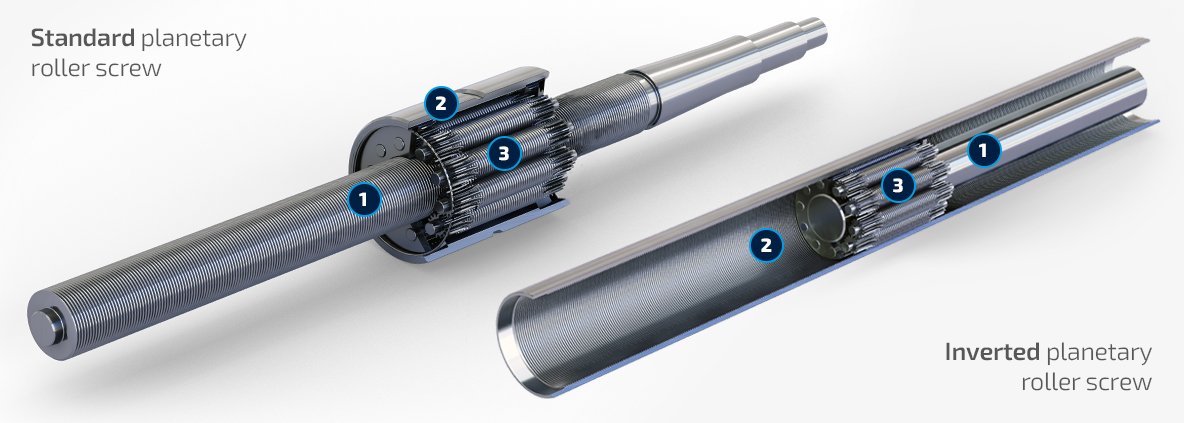
A planetary roller screw consists of three core components: the spindle (threaded spindle), the rollers (threaded rollers), and the nut (threaded nut). The thread rollers are positioned between the spindle and the nut and transmit the driving force simultaneously across multiple contact lines. Compared to ball screws, planetary roller screws offer significantly higher load-carrying capacity with more compact dimensions, as the roller geometry creates a larger contact area than ball contacts.
Planetary roller screws are particularly relevant in applications that require high forces combined with a compact design. In robotics - especially in humanoid robots - they serve, for example, as central drive elements in the joints. In the automotive industry, they are used in electric power steering (EPS) systems and, increasingly, in electromechanical braking systems (EMB). Other areas of application include CNC machine tools, aerospace actuators, and medical devices.
Why is the nut the most challenging component in a planetary roller screw?
The nut of a planetary roller screw features the internal thread in which the threaded rollers move. This internal thread must be manufactured with the highest precision to ensure smooth operation, high load-bearing capacity, and a long service life for the entire system. In an inverse (reversed) planetary roller screw, these requirements are even more stringent: The length-to-diameter ratio of the nut is often 5:1 to 8:1 - with a component hardness of up to 60 HRC after heat treatment.
A typical workpiece - such as a nut for robotic applications - has a total length of approximately 150 mm and an I/D (Inner Diameter) of approximately 20 mm. The surface roughness must reach Ra 0.4. Before heat treatment, the material hardness is 26–32 HRC; after hardening, this increases to 60 HRC, in some cases up to 65 HRC. This combination of bore depth, high workpiece hardness, and extremely tight tolerances (roundness ≤ 0.025 mm, concentricity ≤ 0.025 mm) defines the entire manufacturing process.
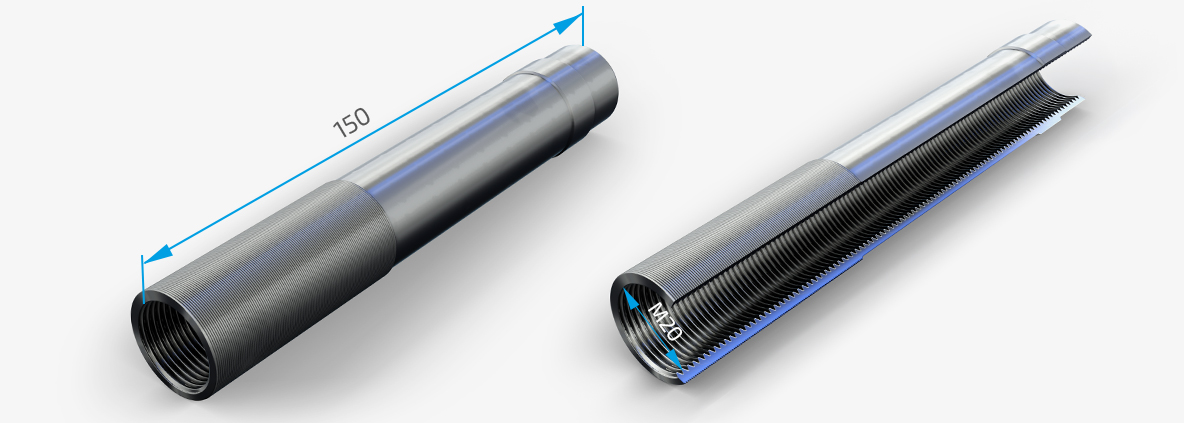
Example for a complete process chain for the manufacture of nuts of a planetary roller screw
| Operation | Designation | Machine | Description |
|---|---|---|---|
| OP 05 | Raw part/material input | - | Forged blank or sawn semi-finished product as raw material |
| OP 10 | Soft turning, side 1 | VL 2 | Precision turning of the first side of the workpiece: end faces, O/D, roughing of the inner bore |
| OP 20 | Soft turning, side 2 | VL 2 | Re-clamping and machining of the opposite side using identical machine technology |
| OP 30 | Heat treatment | - | Hardening to 60 HRC to achieve the required wear resistance |
| OP 40 | Hard turning + grinding of O/D | VT 100 GT | Combination of hard turning and CBN grinding of all external contours in a single setup |
| OP 50 | Fine boring of internal bore + pre-turning of internal thread | VT 200 CD | Precision boring of the internal bore and semi-finishing of the internal thread |
| OP 60 | Grinding of the internal thread | SU (EMAG SU) | Finishing grinding of the internal thread to final dimensions and surface finish |
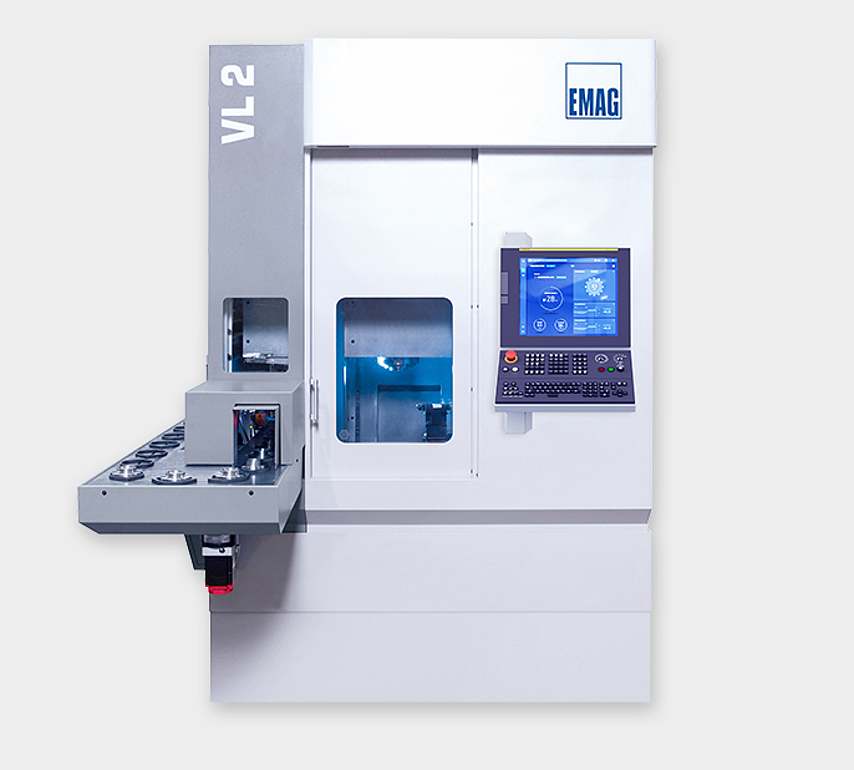
Soft turning of the nut of a planetary roller screw
In the first two machining steps (OP 10 and OP 20), the raw-parts are machined on two EMAG VL 2 vertical lathes. The workpieces are clamped by their O/D and automatically retrieved from the integrated workpiece magazine via the pick-up system, machined, and then returned to the magazine.
The vertical design offers a decisive advantage for deep bores: chips fall out of the bore by gravity. For internal machining operations with a length-to-diameter ratio of 7:1, this ensures reliable chip removal and high process reliability; horizontal lathes often struggle with such geometries. The positive effect of the vertical design can be further enhanced by supplying cutting fluid through the main spindle.
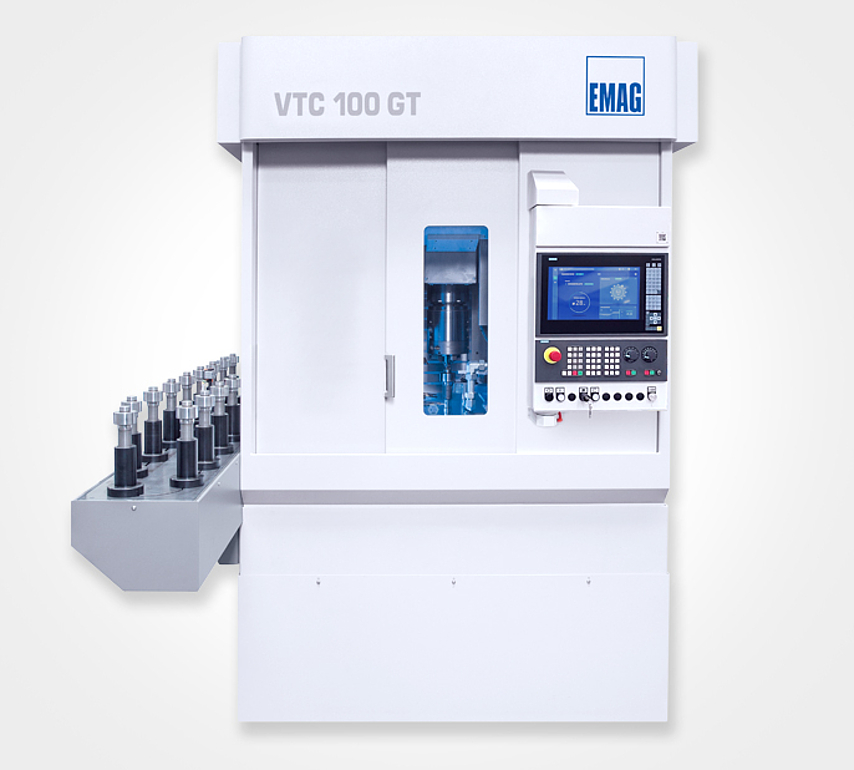
Machining of the O/D on a combined turning-grinding machine
After heat treatment (OP 30) to 60 HRC, the nut must be machined with precision on the O/D to correct heat-treatment-induced distortion. At the same time, these surfaces also form the reference surface for subsequent machining operations. In OP 40, the EMAG VT 100 GT is used for this purpose – a vertical turning machine with an integrated grinding spindle that combines hard turning and CBN grinding in a single setup.
On the left, the machine features an 8-station turret (BMT 55), which integrates an automated loading and unloading gripper as well as a measuring device. On the right is a CBN grinding spindle with up to 30 kW of drive power. In practice, this concept replaces three to four conventional machines: The turret handles the hard turning of the end faces, threads, and milling of the hexagonal features, while the cylindrical outer surfaces are ground in a single pass.
The workpiece is clamped in the inner bore via a mandrel and additionally supported by a tailstock center. This allows for optimal roundness even with long components.
Turning of internal threads in nuts of planetary roller screws
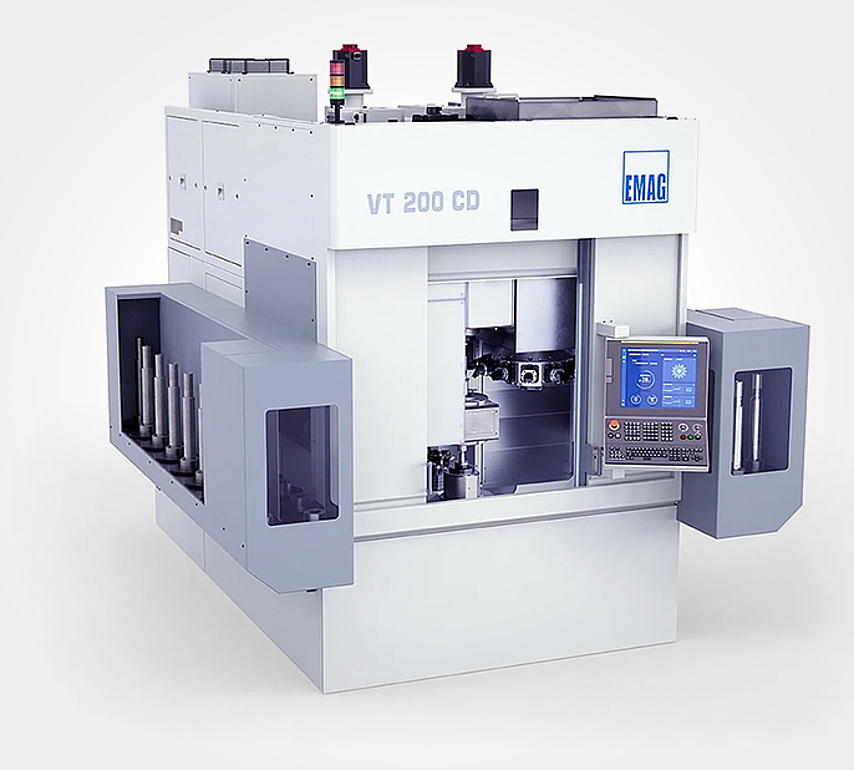
Internal thread machining is the most technologically demanding step in the entire process chain. In OP 50, the hardened nut is machined on the EMAG VT 200 CD – a vertical lathe with center drive based on the proven VT 4 platform.
What is the center drive concept, and why is it crucial for long internal threads?
On conventional lathes, the workpiece is clamped on one side, and the drilling or threading tool protrudes freely into the bore. With a length-to-diameter ratio of 7:1 or more, the long overhang of the tool leads to unstable machining conditions, which can result in the tool being forced out of position, among other issues. This results in vibrations, chatter marks, and geometric deviations. The machining speed must be drastically reduced to achieve an acceptable result – with corresponding losses in tool life and productivity.
The VT 200 CD solves this problem with a center drive: Instead of a work spindle and a tailstock, a centrally positioned hollow spindle with an integrated clamping device grips the workpiece in the center.
What role does chip removal play in the internal machining of planetary roller screws?
Chip removal is one of the greatest challenges when machining long, deep bores. Long chips from the internal thread turning process can wrap around the tool, block the machining space, and, in the worst case, damage the workpiece or tool. In single-part production, this problem can be solved manually - but in high-volume production, that is not an option.
The vertical design of EMAG machines utilizes gravity to assist chip removal. Additionally, high-pressure cutting fluids are directed into the bore. This cutting fluid jet reliably transports the chips downward out of the bore. In series production, the turret remains free of chip clusters, and the process runs smoothly in continuous operation.
How is the internal thread of the nut ground to final dimensions?
In the final machining step (OP 60), the pre-turned internal thread is finished on an EMAG grinding machine. Grinding removes the remaining stock and produces the final thread geometry with the required surface roughness and form accuracy.
Internal thread grinding ensures process stability in batch production. While pre-turning already provides a good approximation of the final contour, grinding compensates for any remaining irregularities and ensures that all thread pitches are within the required tolerances. In practice, pitch errors of less than 2 µm are achieved between individual thread turns.
Comprehensive solution from a single source
EMAG provides the entire process chain for machining planetary roller screw nuts from a single source - from soft turning through hard turning and grinding of the O/D to the finishing of the internal thread.
Workpieces
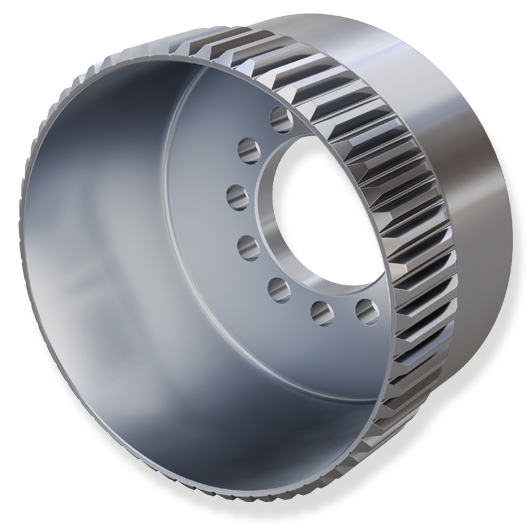
Flexspline
Flexsplines, also known as flexible shaft gears, flex pots, or collar sleeves, form the heart of harmonic reducers. These high-precision components enable very high reduction ratios in a single gear…
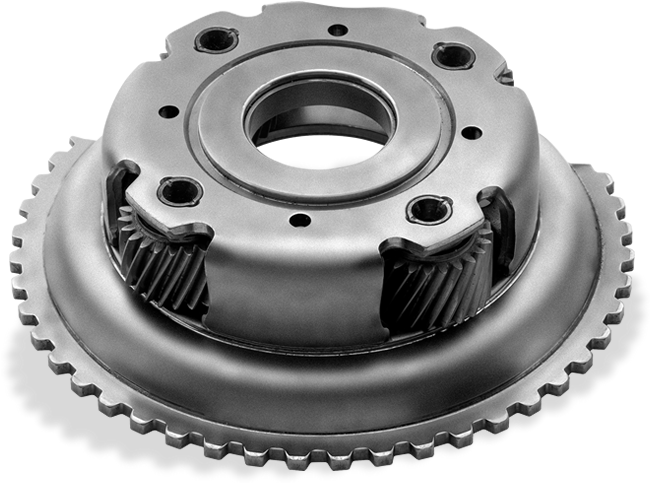
Planetary Gearboxes
Actuators are the fundamental motion elements in humanoid robots - comparable to muscles and joints in a biological organism. They enable precision, human-like motion sequences by converting…
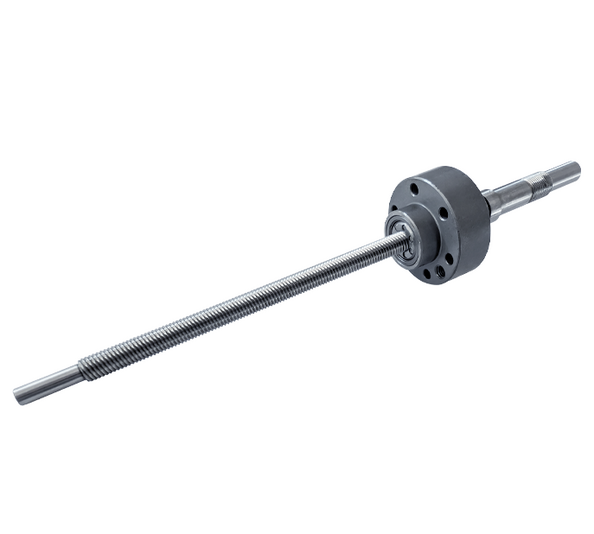
Planetary roller screws
The planetary roller screw is a highly efficient drive component for humanoid robots and positioning systems. The roller screw is the central element whose manufacturing quality determines the…
Wave Generator
The wave generator is the input component in the strain wave gear. It consists of a thin-walled bearing structure (outer ring elastic, inner ring fixed on an elliptical cam) and defines the positive…