Deburring and Chamfering of Gears, Gear Shafts and Gears with Synchronizing Wheel
Deburring is an essential procedure in many production processes - after all, burrs that are not removed could break off later and damage bearings or gears in the gear unit. In addition, burrs (that are still present) cause grinding tools to wear more quickly in the subsequent process, for example.

Short Cycle Times Always “Designed into“ the Deburring
During the mechanical machining of metal, undesired burrs frequently occur. These can be removed using special tools. In addition, the component is given a chamfer.
Flow-turning deburring
Flow-turning deburring is a forming process. With this process, the chamfer is formed using a flow-turning deburring tool and the burr on the face is removed using secondary blades. Using a combined tool, the toothing is smoothed at the same time so that there is no material throw-up in the flank line. Due to the simultaneous machining of both gear sides, this procedure is highly productive and therefore ideally suited for mass production.
Deburring with grinding wheels
For this, a small grinding wheel is positioned on each side of the gearing and pressed against the rotating workpiece by spring force. This method is suitable in the event of large numbers of component variants.
Deburring with hob or side milling cutter
We only offer this procedure as a combination solution on the hobbing machines in the 90° position of the 4-station ring loader. Here a milling cutter is used to deburr and chamfer the right and left sides of the gear without interrupting the main machining operation.
Advantages Deburring
- Indispensable: Deburring prevents premature wear and damage.
- Fast: The combination of deburring and chamfering results in extremely short cycle times.
- Holistic: The secondary burrs of the chamfer are also removed.
Workpieces
The Right Manufacturing Solution for Every Workpiece
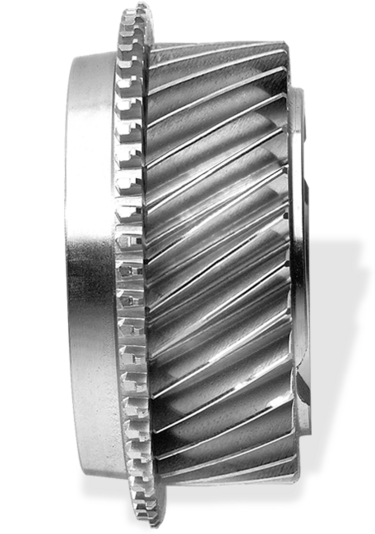
Gear
Machining from raw blank to finished gear– a process that used to take several departments within a shop using multiple experienced operators. Now this process can be done with a pair of digitally…
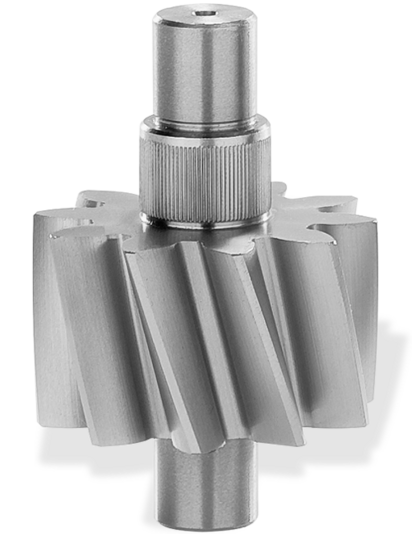
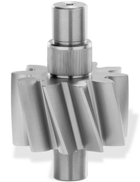
Gear shaft
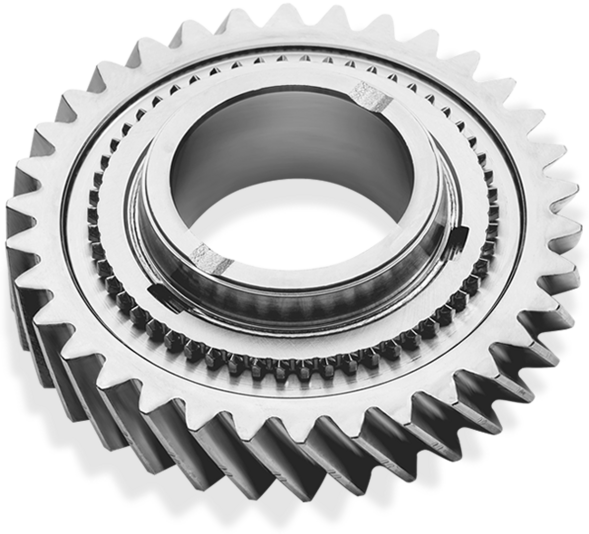
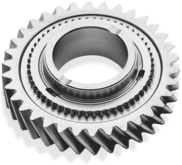
Gear with synchronising wheel
One look at a typical gearwheel shows the machining challenges involved. Even a small wheel with integrated synchronous gear is a relatively complex construction.
Technologies

Technologies
Deburring is an essential procedure in many production processes - after all, burrs that are not removed could break off later and damage bearings or…
For those who want to produce gearing on workpieces with interfering contours – including a small overrun – gear shaping is frequently the only…
Gear shaving takes place before the hardening process and is a cost-effective process. It results in low-noise gear surfaces - a major benefit that…
During the machining of the tooth flanks of shafts and gears by means of generating grinding or gear grinding, it is important to achieve…
Flexible, highly productive, highly accurate - as a continuous gear production process, hobbing is indispensable in many industries, as it allows any…
Power Skiving allows highly efficient machining of chucked parts and gears. For the machining of internal teeth hobbing, it provides an alternative to…
Profile grinding of gears and long, slim and toothed components is performed discontinuously, i.e., tooth gap by tooth gap, is completed one after the…