ECM Technology - Burr-free metalworking of high-strength materials
ECM technology delivers non-contact, thermally and mechanically gentle metalworking. From deburring and drilling to PECM: Achieve the highest surface finish and precision – with virtually any material.

What does ECM technology offer in modern manufacturing?
The principle: electrolysis instead of machining
Electrochemical machining (ECM) uses the principle of electrolysis: the workpiece and tool are connected to a DC power source as an anode and cathode. In an aqueous electrolyte solution, material is removed from the selectively and contact-free – with no mechanical forces and no heat input. The result: surfaces free of residual stress, smooth geometric transitions, and zero burr formation. The material’s microstructure stays fully intact – hardness, toughness, and magnetic properties are never compromised.
ECM Process for Complex Components and Materials
ECM technology works with nearly all metals and shows its strengths where conventional machining hits its limits: with high-alloy materials like nickel-based or titanium-based alloys, as well as hardened components. EMAG offers specialized ECM processes for a wide range of requirements: electrochemical drilling for hard-to-reach holes, ECM deburring for internal burrs, rounding and counterboring for injection nozzles, and PECM for maximum dimensional accuracy in delicate components.
Scalable for series and high-volume production
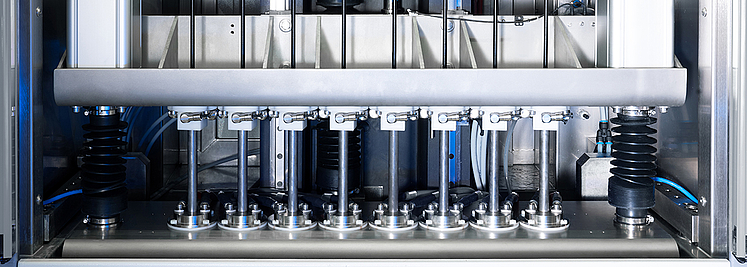
A key advantage of the ECM process in batch production: parallel machining – the simultaneous machining of multiple components in a single fixture – cuts cycle times per component to under ten seconds. On top of that, low tool wear on the cathode ensures long service life and consistent quality. In many cases, post-processing steps such as deburring or polishing are eliminated completely, shortening process chains and reducing costs.
Advantages
- Minimal tool wear, no rework: The cathode experiences virtually no wear during the ECM process. Deburring, polishing, or other rework steps are typically eliminated entirely – saving time and cost in the process chain.
- Thermally and mechanically gentle: ECM operates completely contact-free and without heat input. Material properties like hardness, toughness, and microstructure stay unchanged – even in high-strength alloys.
- Highest surface finish up to Ra 0.05: The ECM process achieves surfaces with a roughness value of up to Ra 0.05. Rough-machining, finishing-machining, and polishing happen in a single operation.
- Burr-free machining, even in hard-to-reach areas: Internal bore intersections, undercuts, and delicate internal geometries are machined burr-free and reproducibly – without secondary burrs or undefined finishing conditions.
- Scalable for batch production: Parallel processing – multiple components machined simultaneously in a single fixture – cuts cycle times to under ten seconds per component. The ECM process scales flexibly with production volume.
- Machining of super alloys and hardened materials: Nickel-based alloys, titanium-based alloys, Inconel, and hardened steels – material hardness has no effect on feed rate or results in the ECM process. Itopens new possibilities where conventional machining methods hit their limits.
Questions and Answers
- How does ECM technology work in principle?
- For which materials and components is the ECM process suitable?
- Which ECM processes does EMAG offer, and how do they differ?
- How can ECM be integrated into an existing process chain?
- What surface finishes and accuracies can be achieved with ECM?
- In which industries is ECM technology used?
- How cost-effective is the use of the ECM process compared to conventional methods?
ECM technology is based on the principle of electrolysis: The workpiece (anode) and the tool (cathode) are connected to a DC power source and material is removed from the workpiece selectively in an electrolyte solution – without direct contact. This process generates no cutting forces and no heat input, eliminating thermal distortion and micro-fissures. The removed material precipitates from the solution as a metal hydroxide. The machining process is irrespective of the material’s microstructure – both soft and hard materials can be machined equally well.
The ECM process works with nearly all metallic materials. It shows particular strengths with high-alloy materials likenickel-based and titanium-based alloys, and Inconel, as well as with hardened materials that are difficult to machine using conventional cutting processes. Even complex geometries with hard-to-reach areas, such as cavities, internal bores, or undercuts, can be machined reliably and reproducibly.
EMAG offers specialized ECM processes for various requirements: ECM deburring removes even internal burrs economically and reproducibly. ECM drilling produces burr- and drill-chuck-free holes even in complex components. ECM rounding and counterboring ensures high-precision internal geometries, for example, in injection nozzles. ECM rifling produces precise internal geometries in rifle barrels. Precise electro-chemical machining (PECM) offers especially high imaging accuracy for delicate components like blisks or turbocharger components thanks to narrow gap control and pulsed current.
ECM complements existing production lines where machining processes hit their limits or rework steps cut into cost-effectiveness. A typical approach pairs machining with ECM deburring, aligning chip direction with the deburring process from the outset. For complex components like blisks, EMAG recommends dividing the process into ECM rough-machining and PECM finish-machining. The modular machine concept allows flexible adaptation of power electronics and generator technology to the respective production conditions.
The ECM process achieves surface finishes down to Ra 0.05 – all in a single operation that combines rough-machining, finish-machining, and polishing. Machining is performed with no residual stress, no thermal influence, and no burr formation. Its very high repeatability makes the ECM process especially suited to series and large-scale production, where consistent quality across many components is crucial.
ECM technology is widely used across aerospace and automotive, toolmaking, and the medical, microsystems, and energy industries. Specific applications range from turbocharger and fuel injector components to pistons with cooling channels and blisks for engines, plus rifle barrels and casings for common-rail systems. Wherever tight tolerances, high-strength materials, and burr-free results are required, the ECM process offers a clear advantages
The economic advantage of ECM technology comes from several factors: The low tool wear on the cathode reduces operating costs, while eliminating rework such as deburring or polishing shortens the process chain. By machining multiple components in parallel within a single fixture, cycle times drop to under ten seconds per component. In ECM deburring, for example, costs can fall significantly compared to mechanical or waterjet processes – and the process stays scalable, growing with production volume.
Technologies

Technologies
Electro-Chemical Machining (ECM) is the generic term for a variety of electro-chemical processes. ECM is used to machine workpieces through the anodic…
Deburring does not count as a core process in machining. On the contrary, it has up to now been considered a necessary evil.
Again and again this has…
Chip-producing drilling is a fast and effective process for many applications.
However, what to do when the pressure on the tool that is supposed to…
Many components do not only have to be highly precise on the outside, but the primary focus is on generating optimal surfaces on the internal…
ECM is the ideal technology for machining rifle barrels. The use of a special rifling module in the modular PI machine produces high-precision…
The use of electro-chemical metal removal processes guarantees surfaces of the highest quality - even on filigreed components. To achieve even greater…