Machining of Screw Shafts for Planetary Roller Screws
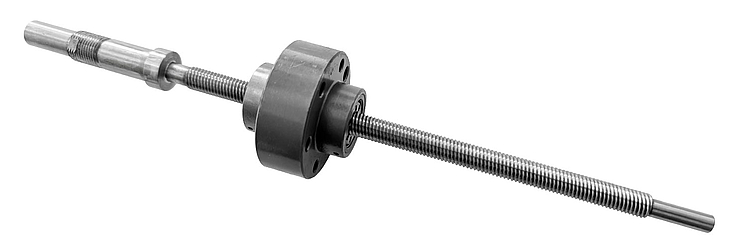
The planetary roller screw is a highly efficient drive component for humanoid robots and positioning systems. The screw shaft is the central element whose manufacturing quality determines the functionality of the overall system. Shape and position tolerances in the single-digit µm range and a surface finish of Ra 0.4 require high-precision grinding processes.
Planetary Roller Screws: Key Component of Modern Drive Technology
Technical Requirements for Screw Shafts
The screw shaft transmits linear movements with high force density and minimal friction. The force is transmitted via several revolving threaded rollers in a planetary arrangement. This enables higher load ratings with more compact designs than conventional ball screws.
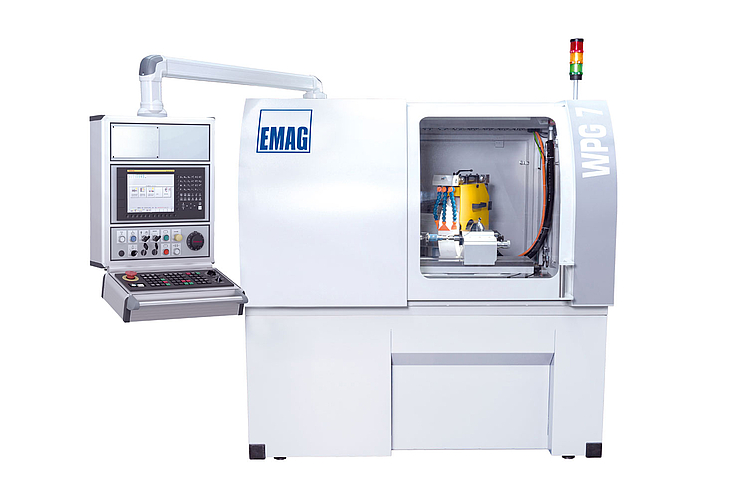
As a specialist in precision manufacturing, EMAG offers a continuous process chain for producing screw shafts in planetary roller screws. With the combination of high-precision cylindrical grinding machines from the WPG 7 series and sophisticated manufacturing strategies, we enable the cost-effective production of these demanding components while maintaining the highest quality.
Workpiece Specifications of the Screw Shaft
The screw shaft for humanoid robots is characterized by a compact design with the highest precision requirements. The starting material is a hardened steel blank with a hardness of HRC 60, which must be ground after heat treatment. The total length of the spindle is typically 110 to 120 mm, where several graduated O/D (Outer Diameter) must be precision ground.
The Complete Process Chain: From Raw-Parts to Finish Machining
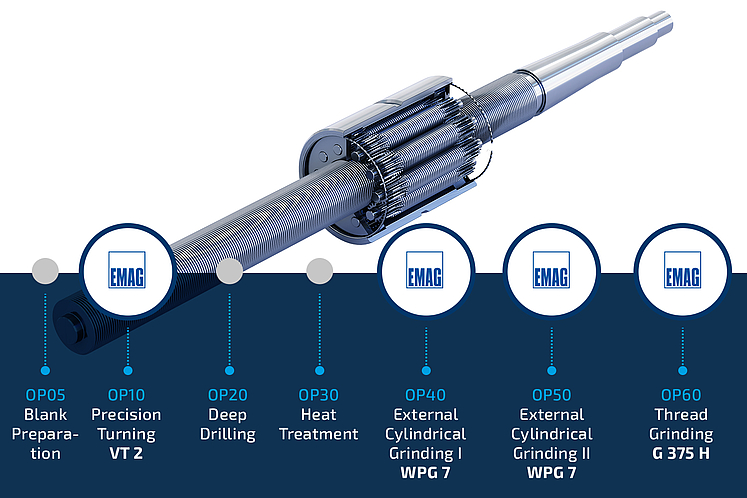
Manufacturing screw shafts for planetary roller screws requires a carefully coordinated process chain that includes several steps from the raw-parts to the finished machined component. EMAG offers optimized solutions for this process chain.
- OP05 - Blank Preparation: The starting material is a steel blank in cylindrical form that has already been pre-machined to the approximate final dimensions.
- OP10 - Precision Turning (VT 2): Pre-machining of the contours is carried out on an EMAG vertical turning machine from the VT series. All diameter increments and end faces are prepared with defined allowances for subsequent grinding.
- OP20 - Deep Drilling: The central bore of the spindle is drilled using a deep drilling process. This bore is essential for weight reduction and serves in part as a guide for subsequent machining steps.
- OP30 - Heat Treatment: Hardening to HRC 60 ensures that the spindle can withstand the high mechanical stresses in subsequent use. After heat treatment, finish grinding is essential.
- OP40 - External Cylindrical Grinding I (WPG 7): First grinding operation for machining the thinner shaft sections.
- OP50 - External Cylindrical Grinding II (WPG 7): Second grinding operation for machining the larger diameters.
- OP60 - Thread Grinding (G375H): Final machining of the precision thread on an EMAG G 375 H thread grinding machine.
Machining Strategy with two WPG 7 Cylindrical Grinding Machines
The challenge in grinding screw shafts is the combination of small diameters, hollow shaft characteristics, and the tightest tolerance requirements. EMAG therefore relies on a two-stage machining strategy with two WPG 7 external cylindrical grinding machines, which is optimally matched to the specific requirements of the component.
OP10: First Grinding Operation - Machining the Thin Shaft Ends
In the first grinding operation, the thin end of the spindle is machined. This area places special demands on the process control due to the low wall thickness (the spindle is hollow). Even low grinding forces can lead to vibrations if the support is inadequate, which can impair both the surface quality and the dimensional accuracy.
OP20: Second Grinding Operation - Machining the Main Diameters
After turning the workpiece, the second grinding operation involves machining the larger diameters. As precision reference surfaces have already been created in OP10, it is now possible to work with a rigid steady rest that is supported on the previously ground surfaces.
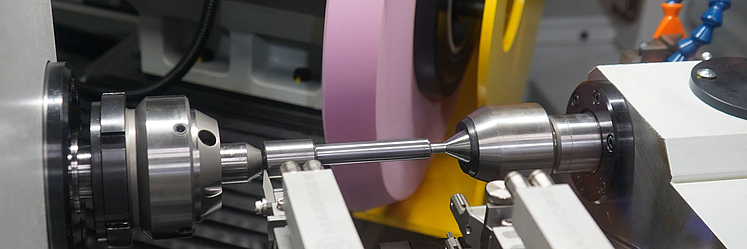
Using helical grinding wheels is crucial for achieving optimum results when machining screw shafts for planetary roller screws. In this process, the grinding wheel is set at a defined angle to the workpiece axis, resulting in several advantages:
- Simultaneous machining of diameter and end faces: the angled wheel enables simultaneous grinding of cylindrical surfaces and shoulders in one operation.
- Improved chip removal: The angle favors the removal of the grinding chips from the contact zone on the shoulder.
- Higher surface finish: The combination of angled plunge-cut and subsequent longitudinal grinding leads to optimum surface roughness.
The abrasives used on the WPG 7 machines are corundum wheels (optional CBN grinding wheels). With a maximum wheel diameter of 500 mm and a wheel width of 80 mm, these offer sufficient capacity for efficient machining. The maximum cutting speed of 50 m/s ensures optimum cutting conditions with controlled heat input into the workpiece.
Advantages of the EMAG Manufacturing Solution for Planetary Roller Screws
The EMAG complete solution for the production of screw shafts offers users in robotics, automation technology and precision mechanical engineering decisive competitive advantages:
- End-to-end process chain from a single source:
from turning and grinding to thread grinding, EMAG offers all manufacturing technologies from a single source. - Optimized machining strategy:
The two-stage grinding process with adapted steady rest concepts guarantees maximum precision with economical cycle times. - Integrated quality assurance:
In-process measurement guarantees compliance with the tightest tolerances without additional inspection steps.
Machines
(1) macchine trovate
Workpieces
Flexspline
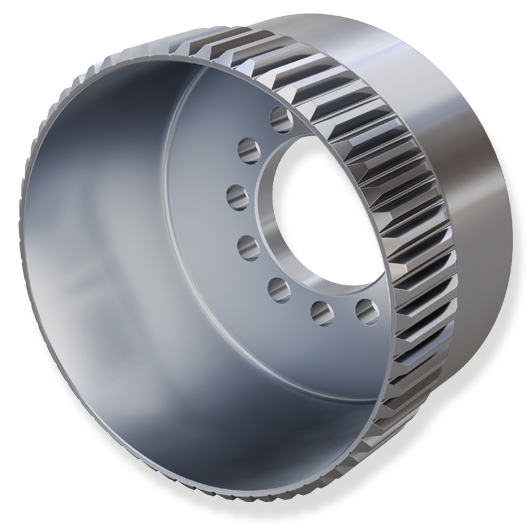
Les Flexsplines, également appelées roues à arbre flexible, manchons flexibles ou manchons à collerette, constituent le cœur des réducteurs à arbre flexible. Ces composants de haute précision…
Wave Generator
The wave generator is the input component in the strain wave gear. It consists of a thin-walled bearing structure (outer ring elastic, inner ring fixed on an elliptical cam) and defines the positive…