Gear Manufacturing – Precision Tooth Profiles from Blank to Finished Surface
Gear production involves a variety of coordinated processes – from turning to gear hobbing and power skiving to grinding. EMAG offers the right machine solution for every step of the process chain.

From soft machining to hard fine machining: A complete process chain for gears
Soft machining: Hobbing and power skiving as productive entry-level processes
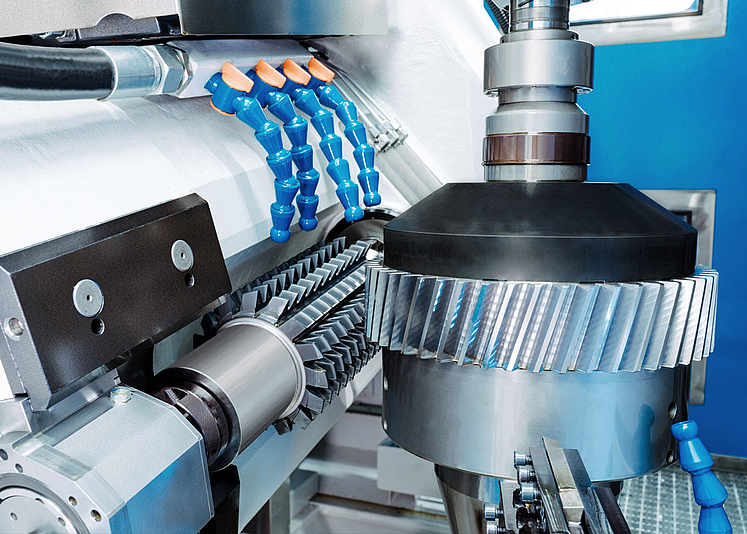
Gear manufacturing begins with soft machining of the blank. In gear hobbing, many cutting edges work simultaneously, which makes the process highly productive and enables any number of teeth, spiral angles, and tooth widths. Power skiving rounds out the portfolio as a high-performance alternative, especially for internal gears. - two to three times as productive as gear shaping.
Gear shaping and deburring: Flexibility for complex geometries
For tooth profiles with interfering contours or small run-out, gear shaping delivers the flexibility you need – for straight and helical internal and external tooth profiles. Following gear cutting, deburring and chamfering are essential: remaining burrs can damage bearings and subsequent tools. We offer three methods: roll deburring, grinding wheel deburring, and deburring with a gear hobbing cutter – tailored to the component quantity and variety.
Hard finishing: shaving, profile grinding, and gear generating grinding for maximum precision
Before hardening, gear shaving ensures low-noise surfaces with high productivity – a proven process in the automotive industry. After heat treatment, gear generating grinding or profile grinding eliminates manufacturing-related dimensional deviations.
Advantages
- End-to-end process chain: From soft machining to hard finishing, EMAG covers every step of gear manufacturing with coordinated machines and processes.
- High productivity: Processes like gear hobbing and power skiving enable short cycle times through continuous machining with multiple cutting edges—reliably reproducible even for large production volumes.
- Precision at the micrometer level: Gear generating grinding and profile grinding after heat treatment eliminate dimensional deviations—a critical factor for smooth running and service life.
- Flexibility for a wide range of geometries: Whether internal or external gear teeth, straight or helical, with interfering contours or small run-out—EMAG offers the right process for every requirement.
- Fewer reclamping errors: By combining multiple operations in a single setup—e.g., turning and power skiving—largely eliminates concentricity errors and simplifies parts logisitics.
Questions and Answers
- What manufacturing processes are generally used in gear production?
- What special requirements do gears place on machining?
- Which process is suitable for internal gear teeth in gear manufacturing?
- What does a typical process chain in gear manufacturing look like?
- In which industries and application areas is gear manufacturing particularly relevant?
- How can cost-effectiveness in gear manufacturing be specifically improved?
Gear manufacturing is divided into soft machining and hard machining, each requiring different processes. Soft machining includes gear hobbing, power skiving, and gear shaping, which cut the tooth profile into the component before hardening. After heat treatment, hard finishing is performed via gear generating grinding or profile grinding to correct distortion errors and create precision surfaces. Deburring and chamfering complete the process chain as indispensable intermediate steps.
Gears require tight tolerances on tooth form, flank lines, and surface finish – even minimal waviness at the micrometer level can cause noise in the drive. Interfering contours, small run-outs, and internal gear teeth add further challenges, limiting the use of certain processes. Dimensional deviations from heat treatment must be deliberately compensated in hard machining. For electric drives, the demands on smooth running and surface finish continue to increase.
For internal gear cutting, EMAG primarily offers the processes of power skiving and gear shaping. Power skiving is the more productive choice: It operates continuously with axial feed and is two to three times faster than gear shaping. For workpieces with interfering contours or very small clearance, gear shaping offers design advantages, as the tool operates with precision even in confined spaces.
A complete process chain begins with pre-turning of the blank, followed by rough gear cutting by gear hobbing or power skiving. Burrs are removed next, by roll deburring or deburring discs. After hardening, gear generating grinding or profile grinding handles finishing. The result: dimensionally accurate tooth profiles with a defined surface finish and long service life.
Gear manufacturing is a core process wherever torque is transmitted – especially in automotive and its supplier base, commercial vehicle manufacturing, and agricultural machinery. Gear manufacturing is also becoming increasingly important for electric drives: High torques and motor speeds require particularly low-noise surfaces and tight tolerances. For this, EMAG provides specially tailored solutions – planetary gearboxes or bevel gears in electric vehicles, for example.
Key factors include short cycle times, minimal non-productive time, and few setup changes. Power skiving in a single setup with pre-turning reduces part handling and concentricity errors simultaneously. In gear generating grinding, a second workpiece spindle lets loading and unloading happen within the cycle time. Deburring directly on the gear hobbing machine saves a process step. Gear shaving costs less than grinding and still achieves low-noise results – a clear advantage for high-volume production.
Technologies

Technologies
Deburring is an essential procedure in many production processes - after all, burrs that are not removed could break off later and damage bearings or…
For those who want to produce gearing on workpieces with interfering contours – including a small overrun – gear shaping is frequently the only…
Gear shaving takes place before the hardening process and is a cost-effective process. It results in low-noise gear surfaces - a major benefit that…
During the machining of the tooth flanks of shafts and gears by means of generating grinding or gear grinding, it is important to achieve…
Flexible, highly productive, highly accurate - as a continuous gear production process, hobbing is indispensable in many industries, as it allows any…
Power Skiving allows highly efficient machining of chucked parts and gears. For the machining of internal teeth hobbing, it provides an alternative to…
Profile grinding of gears and long, slim and toothed components is performed discontinuously, i.e., tooth gap by tooth gap, is completed one after the…