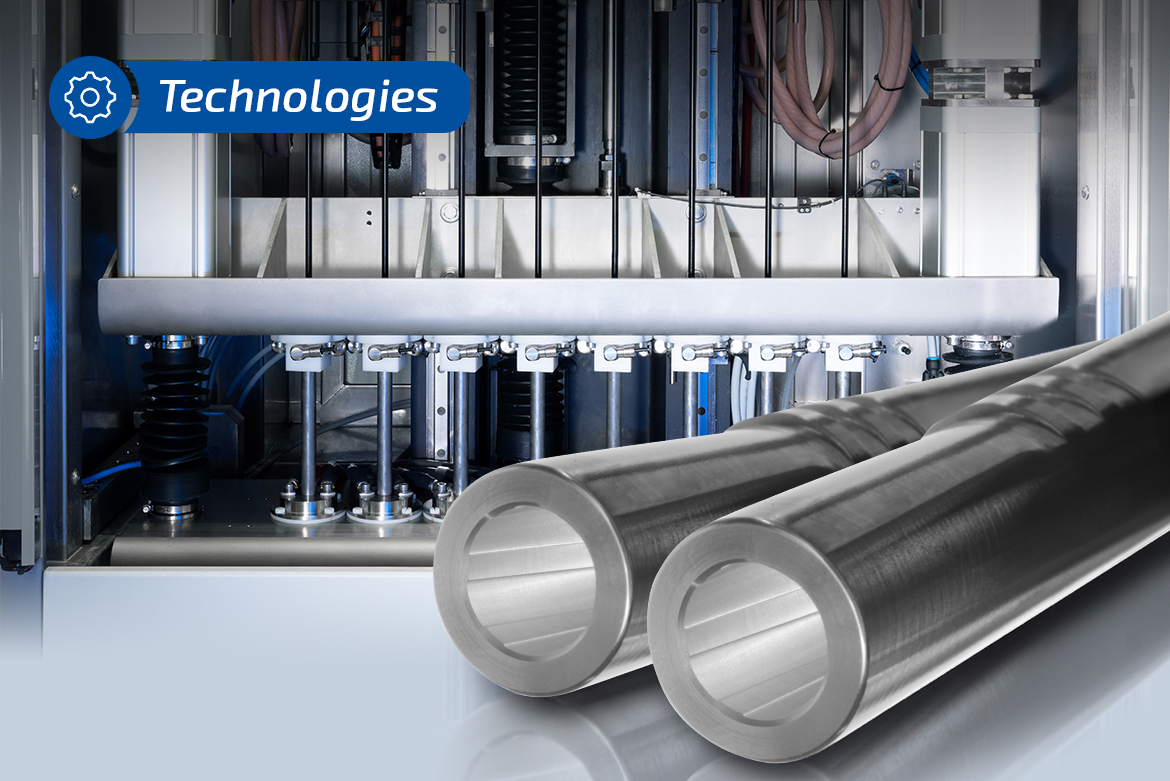
Weapon barrel manufacturing ranks among the most demanding challenges in long-part machining. Extreme length-to-diameter ratios, tight concentricity tolerances, hard-to-machine materials, and the unique internal geometry with rifling and lands present unique challenges at every process step. This article describes the complete process chain from the sawn raw-part to the barrel ready for installation. Comparing a hammered tube to one machined with ECM highlights the machining and process requirements needed for reliable production. This example doesn’t cover other rifling methods, like button rifling or cut rifling.
Requirements for the Finished Weapon Barrel
Before examining the individual machining steps, it is worth looking at the requirements the end product must meet. A rifle or pistol barrel is a high-precision component whose function depends directly on the dimensional accuracy and surface quality of both the internal and external contours.
Typical requirements for a rifle barrel:
- Concentricity between centers: less than 0.1 mm over a total length of approximately 600 mm
- Length-to-diameter ratio: up to 36 × D – in this example, a diameter of 15 mm with a length of 497 mm plus the chamber area
- Internal contour with rifling and lands: land tolerances of approximately 5 µm, rifling profile tolerances of around 50 µm, rifling depths (rifling dimensions) typically 0.2 mm for calibers up to 0.5″
- Cartridge chamber: precisely formed and protected from damage during subsequent external machining
- Length tolerance between the cartridge chamber taper and the outer surface: tightly controlled, as it is critical for subsequent coupling with the breech system
- Internal surface quality: Ra up to 0.1 µm, depending on the material
The material used is typically designed for forming processes (hammering) and consequently exhibits poor chip breaking properties. Combined with the slenderness of the workpiece, this results in a manufacturing challenge that can only be economically solved with carefully coordinated workholding technology, tool guidance, and measurement technology.
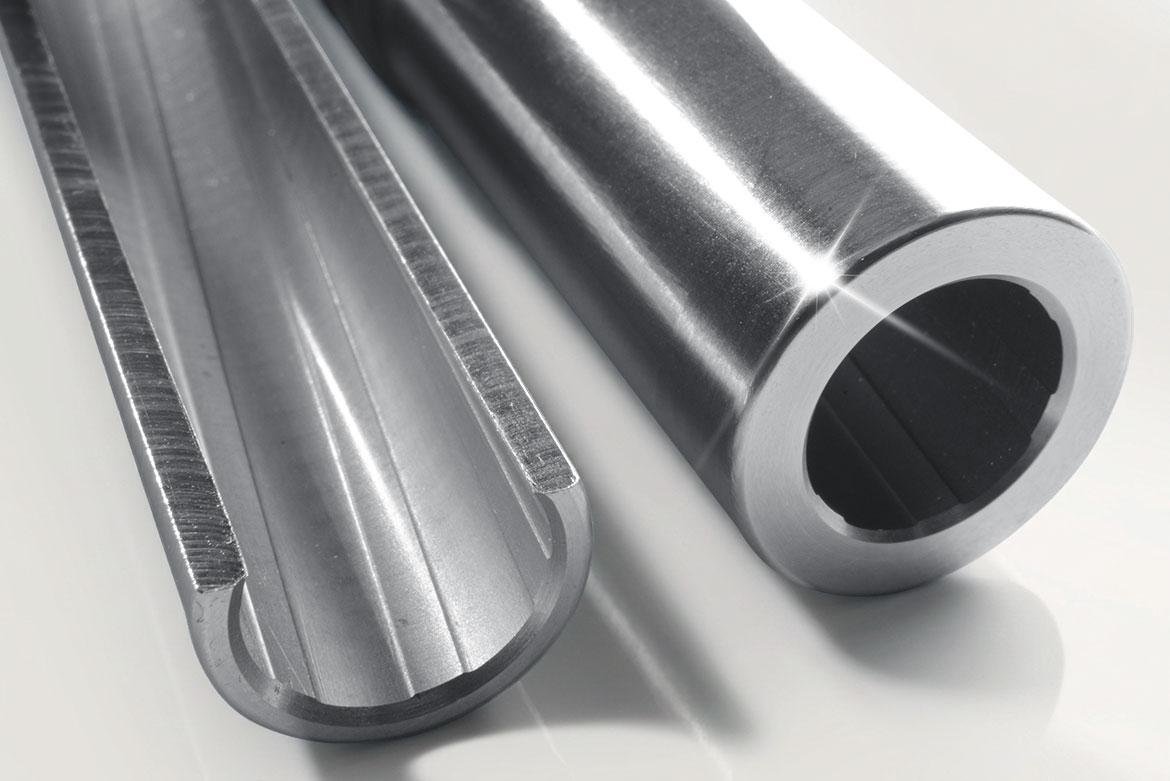
Cross-section of a gun barrel with precision-formed rifling grooves and lands. The internal geometry is critical for guidance, twist, and dimensional accuracy.
Two Approaches, One Goal: The Rifling Strategy Determines the Process Chain
In modern barrel manufacturing, two methods for producing the internal geometry have become established: cold forging and ECM rifling (electrochemical machining). The choice of method shapes the entire process chain. In particular, the sequence of turning and deep-hole drilling operations differs significantly.
The following section covers common pre-machining steps, then both rifling methods, and finally the common finishing process.
Preliminary Machining:
Sawing and Cutting
The process chain begins with cutting the raw material from the bar. The length of the sawn section depends directly on the selected rifling method.
- For the hammer-forging method, the blank is cut to a significantly shorter length – typically 350 mm – since the process later stretches the workpiece to its final length.
- For the ECM method, the blank is cut close to the finished length, since no stretching occurs during the ECM process.
This decision is far more than a logistical issue: it determines which subsequent processes can even be performed on turning and deep-hole drilling machines.
Chamfering and Facing for Deep-Hole Drilling
The sawn raw-part undergoes a chamfering and face turning operation on its end face. This creates a defined contact surface and a clean entry geometry for the drill bit used in the subsequent deep-hole drilling. It becomes clear right here: Any inaccuracy in the chamfer carries through to the entry of the deep-hole drill and can lead to deviations along the entire length of the hole.
Deep-hole drilling
Deep-hole drilling creates the through-hole that later defines the caliber. Depending on the barrel geometry, this operation runs either on a dedicated deep-hole drilling machine or, for shorter workpieces like pistol barrels, on a combined turning-and-drilling machine.
EMAG’s VT series offers a compelling option here: For short workpieces like pistol barrels or firearm barrels (for the hammering process), deep-hole drilling integrates using the movable center drive and a lower spindle unit. For long rifle barrels already at final length prior to rifling (ECM method), a separate deep-hole drilling machine is required, since the workpiece is simply too long to integrate with the existing system.
External Turning/Reference Turning
Deep-hole drilling is followed by reference turning: Based on the internal bore, the external contours are prepared to ensure a defined alignment between the internal and external geometries. This step forms the basis for the subsequent rifling process, since rifling can only achieve full precision from a clean internal-external reference.
Rifling: The Central Process Decision
Between pre-turning and finishing lies the heart of firearm barrel manufacturing: creating the internal contour with grooves and fields. Both methods – hammering and ECM rifling – are in use today, resulting in different process chains, each with its own strengths.
Rifling Method 1: Hammering (Cold Forging)
In hammering, the workpiece is formed at a high frequency by four radially arranged hammers. Inside is a mandrel that carries the profile geometry of the rifling grooves and lands. The radially applied forming force causes the material to take on the negative shape of the mandrel. Internal geometry and external contours form simultaneously in a single operation.
Characteristics of the hammering process:
- The workpiece stretches during the process. A blank approximately 350 mm long extends to a final length of 550 mm or more.
- The outer surface takes on a characteristic “spiral” pattern with visible forming marks.
- The material is compacted in the formed area and hardens locally; this increases strength but also makes subsequent machining more difficult (poorer chip breaking).
- A subsequent straightening operation is usually necessary, as mechanical forces during hammering lead to deformation.
- Not all materials are suitable for hammering; very thin or very thick barrels are more difficult to form.
Hammering is a well-established, productive process with a long tradition in weapons manufacturing. Its main limitation is the mechanical stress placed on the workpiece and the resulting need for straightening. By comparison, ECM rifling stands out for its lower acquisition costs and greater flexibility.
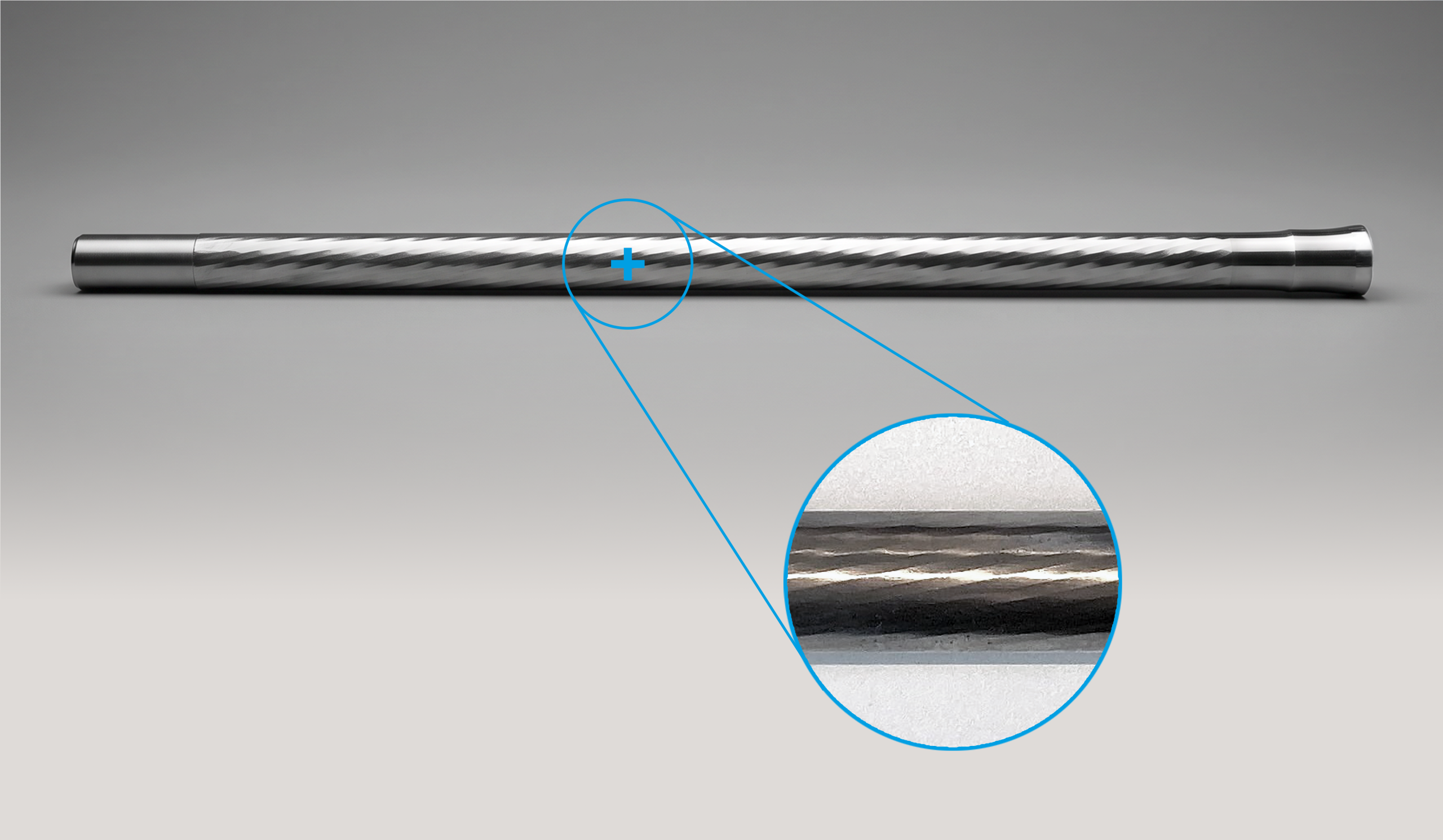
Raw-parts with a hammered surface following the cold forging process. The close-up shows spiral-shaped forming marks on the external contours.
Rifling Variant 2: ECM Rifling (Electrochemical Machining)
Electrochemical machining (ECM) is a non-contact process: A pulsed current flows through a conductive electrolyte between the metallic workpiece (anode) and the tool, known as the cathode. This removes metal in a controlled manner – without mechanical force, without heat generation in the workpiece, and with only minimal wear in the traditional sense. No subsequent heat treatment or straightening of the barrels is necessary. In addition, all common metals, including titanium and Inconel, can be machined.
Characteristics of ECM rifling:
- Feed rate: approximately 85 mm/min (depending on the material) to achieve a surface roughness of Ra 0.1
- Field tolerance: approximately 5 µm; rifling depth tolerance: approximately 50 µm
- Rifling depth: 0.2 mm for calibers up to 0.5″
- No mechanical stresses or thermal stresses on the workpiece – no straightening operation required
- Hardened materials machine at the same speed as soft materials.
- Smooth transitions between the field and the draw reduce deformation forces on the projectile and minimize wear on the barrel
- Barrels already externally finished can also be machined, since no subsequent straightening operation is required
Process times (example):
- Rifle barrel, 560 mm long: Process time approx. 400 seconds; with an 8-station machine, this results in a cycle time of 65 seconds per component – at a rate of about 55 barrels per hour
- Pistol barrel, 109 mm: Process time 77 seconds; cycle time 21 seconds per component (8-station) or 81 seconds (2-station)
EMAG offers two machine concepts for this purpose: an 8-station machine for long and short firearms and a 2-station machine for lengths ranging from 50 to 1,000 mm. Retooling between calibers requires only a cathode change, which takes about three minutes per station. The complete retool for the entire machine is completed in about ten minutes.
The cathodes themselves have a very long service life. In practical tests, 300 barrels were produced without measurable wear; subsequently, 400 to 500 barrels could be machined without any loss of quality – provided the barrels met the required input quality standards.
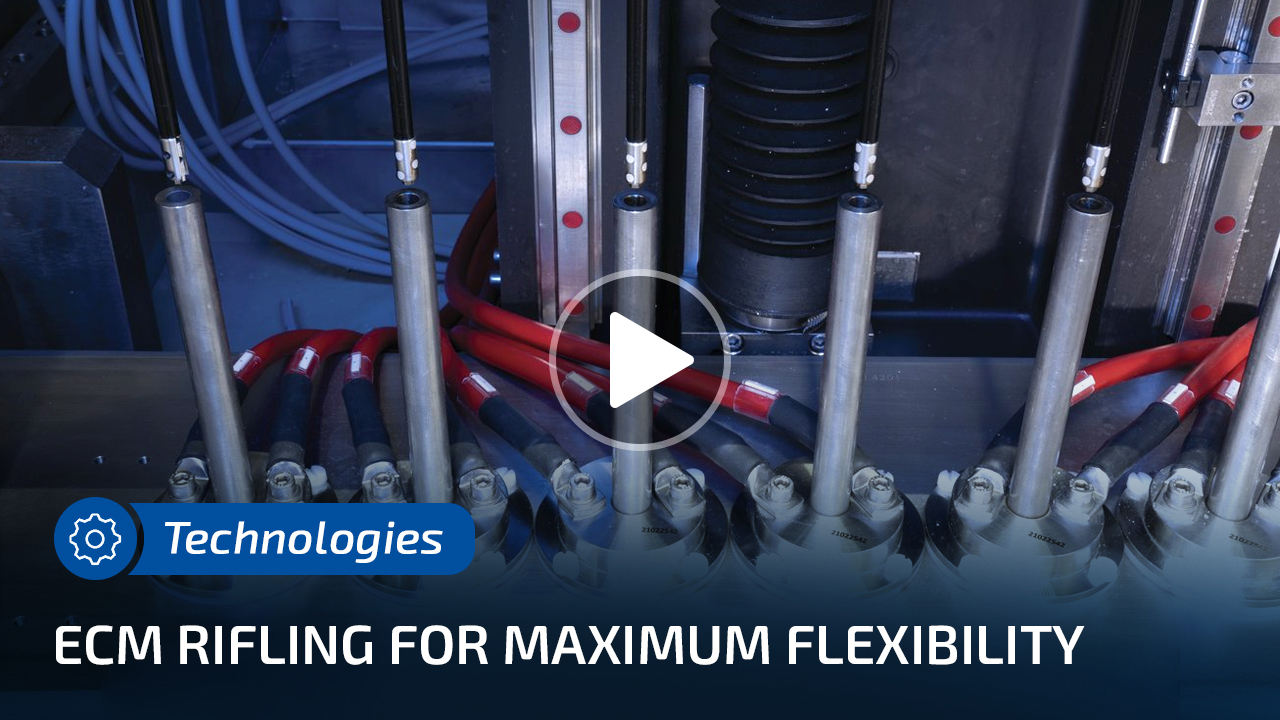
ECM rifling using the PI 2500 and PI 800 machines. The video shows the electrochemical machining of barrels to achieve precision in internal geometries.
Hammering or ECM – what does this mean for the process chain?
The decision to use one of these two processes has far-reaching consequences for the entire manufacturing process:
Hammering Process:
Sawing → Chamfering → Deep-hole drilling → Reference turning → Hammering (simultaneous machining of external and internal geometries, stretching to final length) → Straightening → Cartridge seat/external turning → Drilling/milling
ECM Process:
Sawing (already at final length) → Chamfering → Deep-hole drilling → Honing → ECM rifling → External turning → Chamber/external turning → Drilling/milling
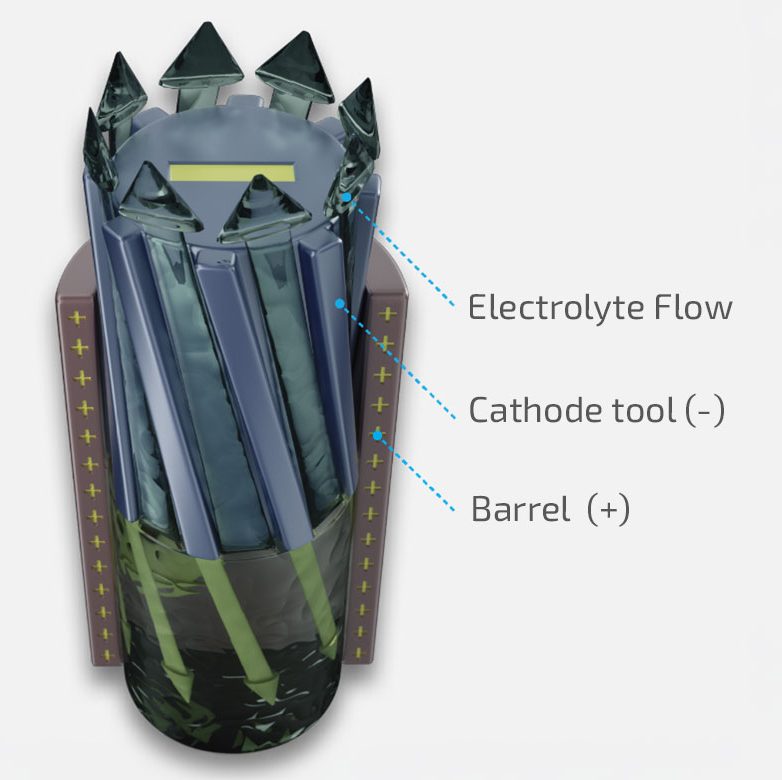
Schematic representation of the ECM rifling process. The tool creates the internal contour without contact, forming ridges and grooves as it moves.
The key difference:
With the hammering method, deep-hole drilling can run on short blanks and thus on a combined turning-and-drilling machine. With the ECM method, the blank is already too long, so a dedicated deep-hole drilling machine must be included in the layout.
Finishing:
Chamber and final external turning
Regardless of the rifling method selected, the barrel’s final external machining follows. This step turns the final diameters, lengths, and transitions to the chamber side – both machining operations can run on our EMAG VT series. Due to the existing internal contour, special requirements apply here:
- The internal contour of the chamber must not be damaged. Direct clamping in the taper is not an option.
- An additional allowance of typically 2 mm on the end face, combined with an internal chamfer (e.g., 2 × 60°), creates a clean centering surface for turning.
- This allowance is removed at the end of the process along with the chamfer.
From a process engineering perspective, this finishing operation is the most demanding turning operation in the entire process chain. The next section covers these challenges in detail.
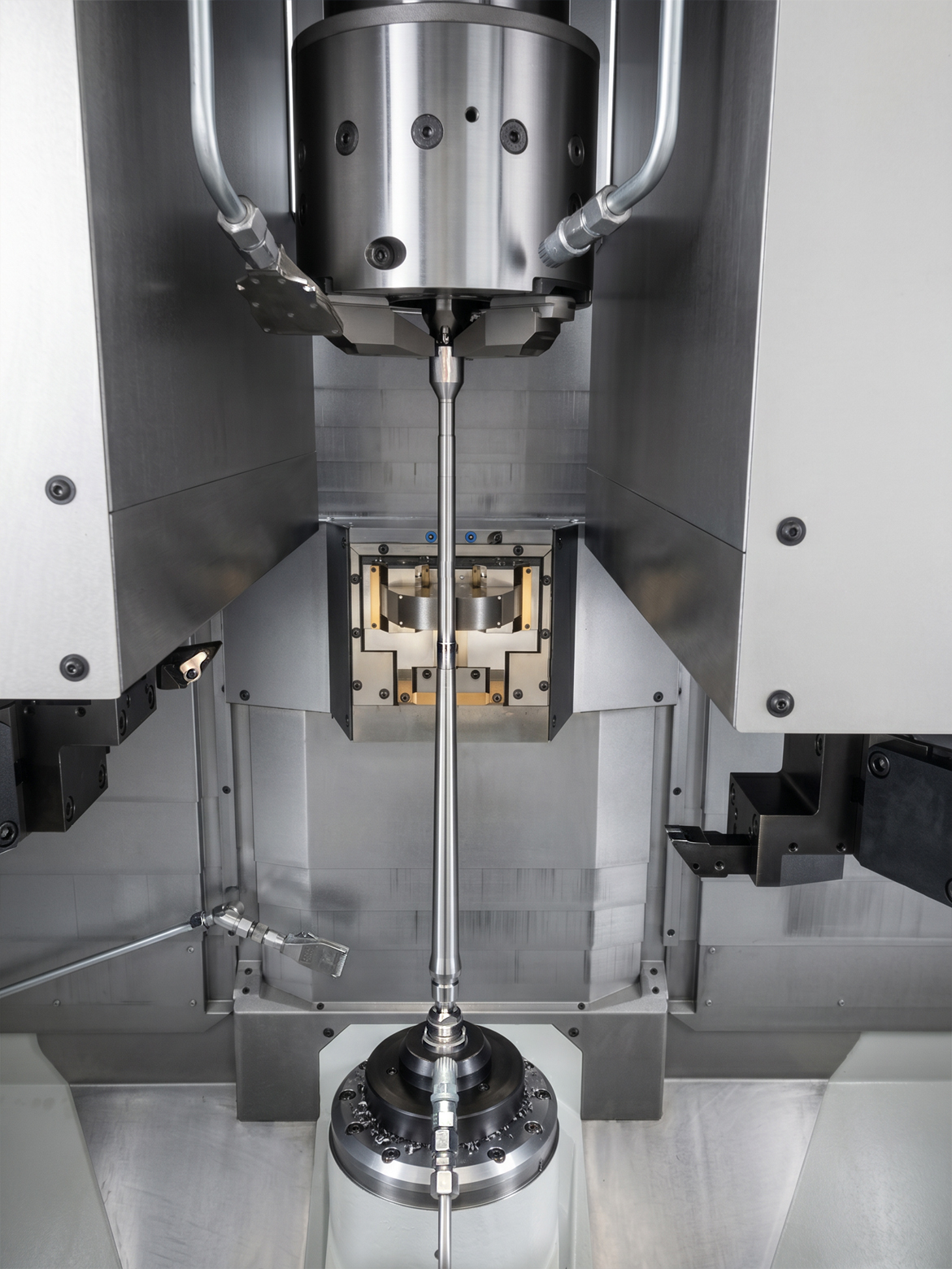
Work area of an EMAG VT 4 for machining long firearm barrels. The barrel is being clamped vertically between the spindle and the tailstock.
Drilling and Milling
In the final machining step produces the non-radially symmetric geometries: cross holes, milled recesses for the front sight and rear sight, mounting surfaces for the locking system, threads, or flutes. In many cases, these operations can run directly on the lathe, thanks to the Y-axis and driven tools. This is particularly common on machines such as the long-version EMAG VT 4.
The Challenges of Turning in Detail
Although rifling is often perceived as the most demanding component of the process chain, turning the external contours is in many cases the real bottleneck: Long, slender workpieces, tight concentricity tolerances, and a hard-to-machine material demand a precision-turned design.
Workpiece and Operating Conditions
A typical rifle barrel, as processed in modern batch production, has the following key specifications:
- Length: approx. 600 mm with a diameter of 15 mm – corresponding to a length-to-diameter ratio of approximately 36 × D
- Material: steels designed for forming with poor chip breaking behavior
- Compacted edge zone after hammering (if this method was chosen)
- Existing chamber, which must not be damaged
A steady rest is absolutely necessary for L/D ratios of 14 × D or higher. At 36 × D, a single steady rest isn’t enough – it must be repositioned multiple times during the process to support all areas of the barrel with minimal vibration.
Vibrations and concentricity – the core issue
The greatest challenge in turning long barrels is avoiding vibrations (chatter). Any inadequately damped excitation leads to surface defects and dimensional deviations that quickly exceed the tolerance when the target runout is less than 0.1 mm. In practice, well-designed processes achieve runout values of 0.05 to 0.06 mm – roughly twice the theoretical measurement uncertainty.
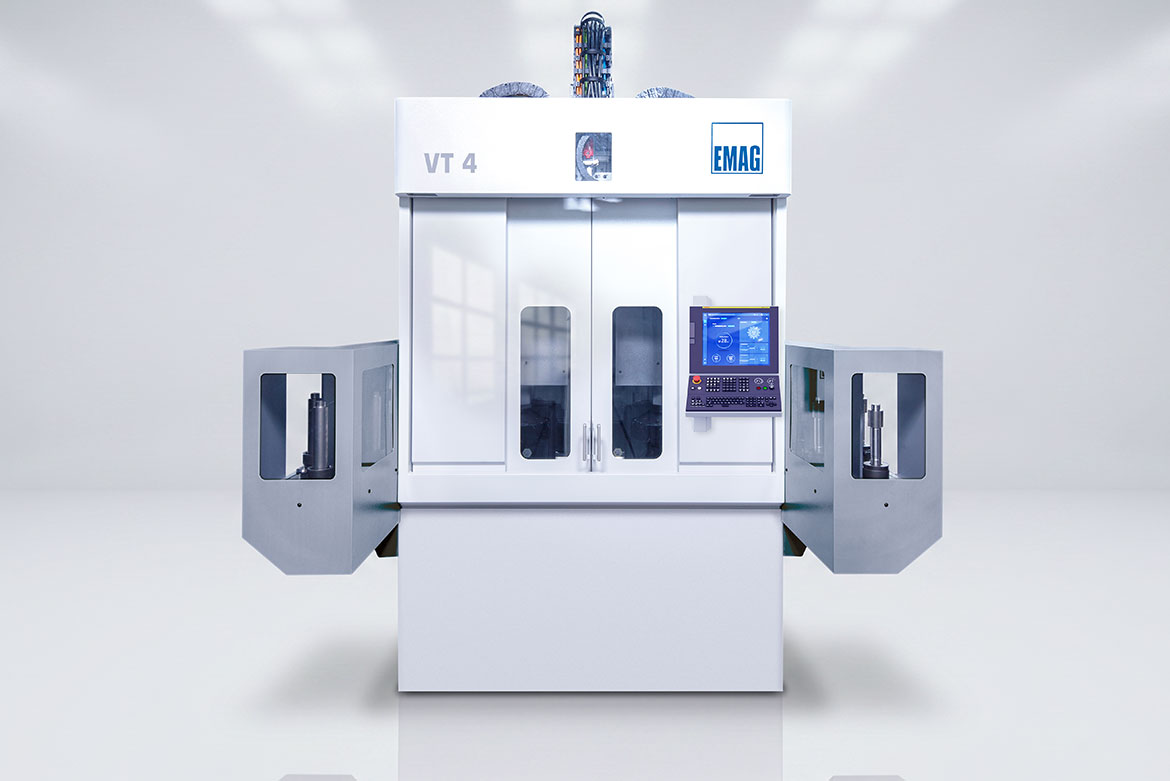
The EMAG VT 4 is designed for the vertical machining of long workpieces. The machine concept is suitable for, among other things, shaft machining.
The Right Machine: VT 4 in the Long Version
The long version of the EMAG VT series has proven itself for long rifle barrel turning. The standard version offers 870 mm of space between the spindle and the tailstock; the long version provides up to 1130 mm.
Additional machine requirements:
- Two turrets (typically BMT65), with the left side optionally equipped with a Y-axis and driven tools for the milling operations in OP 70
- Main spindle with sufficient power (e.g., 29.3 kW)
- Center drive with a movable axis (deep-hole drilling up to 380 mm)
- Drilling spindle with high-pressure system mounted at the bottom
- Movable steady rest with electronically controlled positioning
- Hydraulic tailstock, retractable and with adjustable clamping force
- Standard Type O transport system for up to 27 workpieces – the existing standard automation handles long runs without requiring a custom solution
One process chain, two methods, many details
The complete-machining of a firearm barrel results from a precision-coordinated chain of sub-processes. Rough machining from OP 05 to OP 30 lays the foundation; rifling – whether by hammering or ECM – creates the functionally critical internal contour; finishing from OP 60 onward produces the final required dimensions.
The choice of rifling method determines not only the result but also the process logic: Hammering allows integration of deep-hole drilling on short blanks, but requires subsequent straightening operations and is suitable only for certain materials. ECM rifling is material-independent and force-free, but requires a separate deep-hole drilling machine, since the blank is already cut to its final length.
The actual turning operation – regardless of rifling method – is the most technically demanding operation: an L/D ratio of 36 × D, concentricity requirements below 0.1 mm, and materials that are difficult to machine make it a highly challenging manufacturing task.
EMAG offers the right machines and the necessary process expertise from a single source for both rifling methods – hammering and ECM – as well as for the demanding turning process. This transforms a chain of individual processes into a seamless, economically viable manufacturing process – from the raw-parts to the ready-to-install gun barrel.