Scroll free turning is a turning process developed by EMAG in which a straight cutting edge, set at a 45-degree angle, sweeps tangentially past the rotating workpiece. The point of contact continuously moves along the cutting edge. This produces twist-free surfaces with grinding-quality finishes – significantly faster than with conventional finish-machining and completely dry.
Scroll free turning of seals and bearings, laminated cores with defined surface roughness, and cycle times more reminiscent of rough-machining than finishing: scroll free turning has established itself as a standard in shaft machining, particularly in the field of electric drives. Time for the five most important questions and answers about this technology.
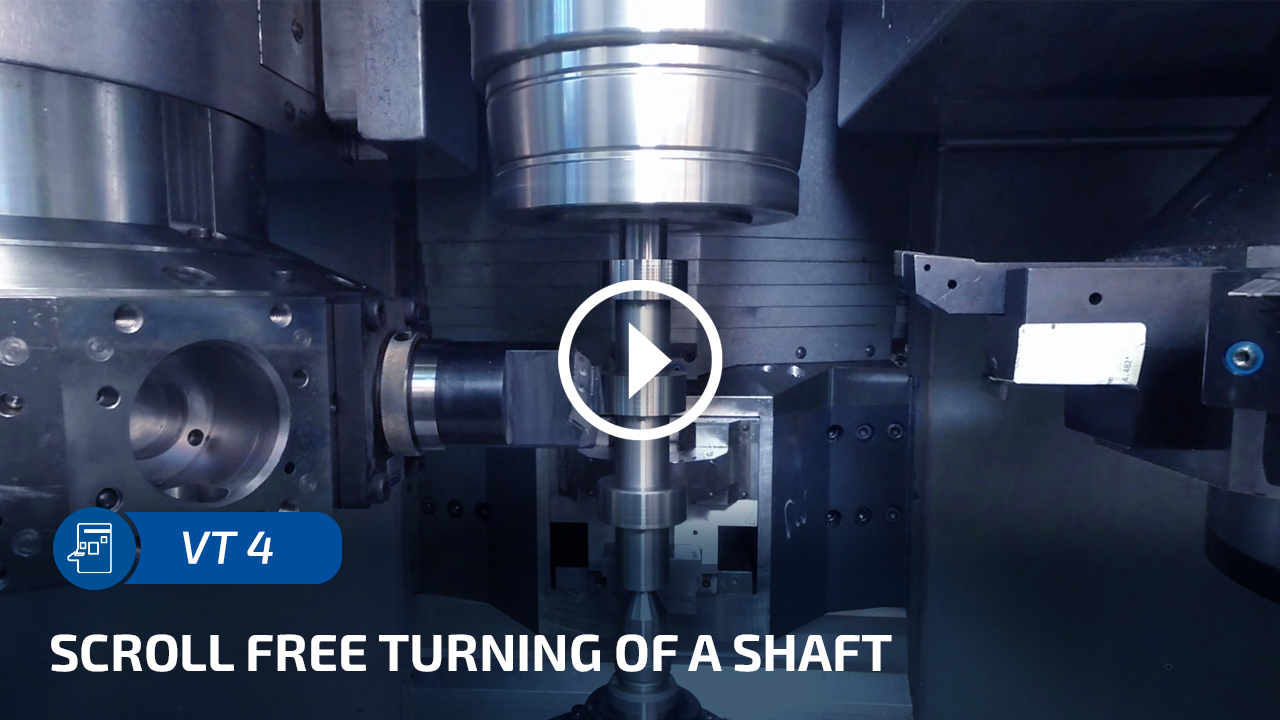
Scroll free turning in practice: In the work area of the EMAG VT 4, the scroll free turning tool machines a vertically clamped shaft.
1. Why was scroll free turning developed?
The trigger was the twist. In conventional longitudinal turning, the corner radius of the cutting edge, the feed rate, and the rotation of the workpiece create a fine, thread-like groove structure on the surface. On a seal seat, this structure acts like a screw conveyor: it transports oil beneath the radial shaft seal ring—causing the system to leak. For this reason, many drawings for seal seats explicitly require the surface to be free of tool marks, usually combined with surface roughness values of Rz 1 to 4.
For a long time, such surfaces could only be produced by grinding. The goal of EMAG’s technology development was to create an alternative with a defined cutting edge that runs directly on the lathe – without an additional grinding operation and without cutting fluids. The result is scroll free turning, which has been in use in series production projects for well over a decade.
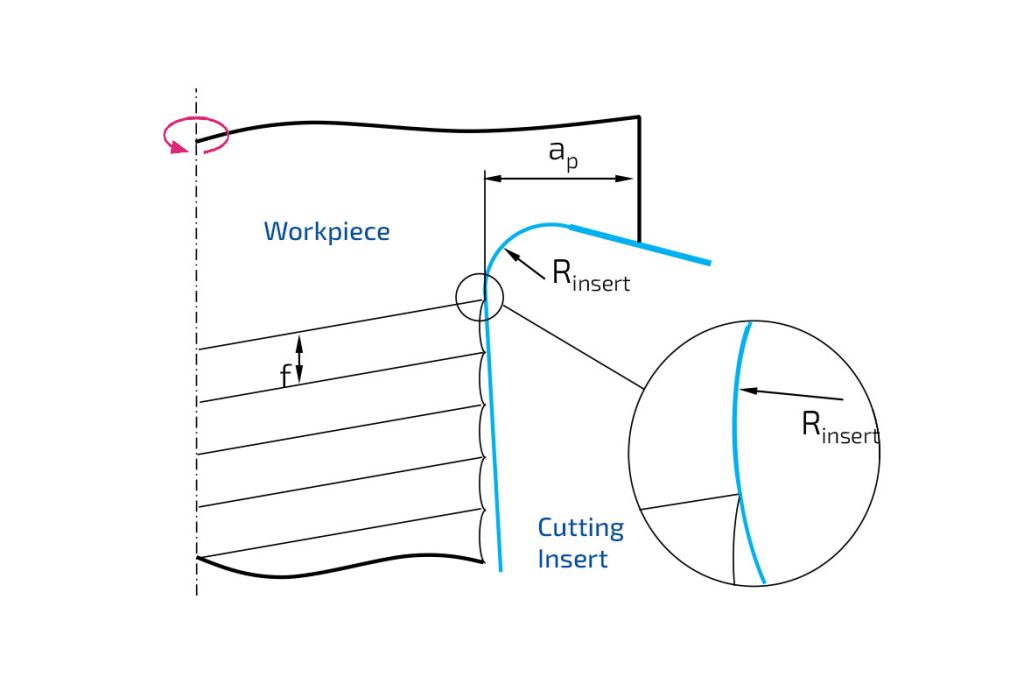
In conventional turning, the cutting edge radius and feed rate create a thread-like groove structure known as a spiral. At seal seats, this spiral channels the oil beneath the radial shaft seal.
2. How does scroll free turning work?
In scroll free turning – sometimes also referred to as tangential turning – a straight cutting edge up to 50 millimeters long is used, set at a 45-degree angle. The workpiece rotates as is customary in turning. However, the cutting edge does not move axially along the workpiece but sweeps tangentially past it; a superimposed compensating motion ensures the precise cylindrical shape.
The key effect: The point of contact continuously moves along the cutting edge. Each point on the cutting edge is in contact for only a fraction of a second; the chip rolls off the cutting edge, carrying away almost all of the process heat. This allows for high cutting speeds of 250 m/min and more, with completely dry machining. For longer machining lengths, a Z-axis movement can also be superimposed; this further increases productivity, but the surface is generally no longer free of twist.
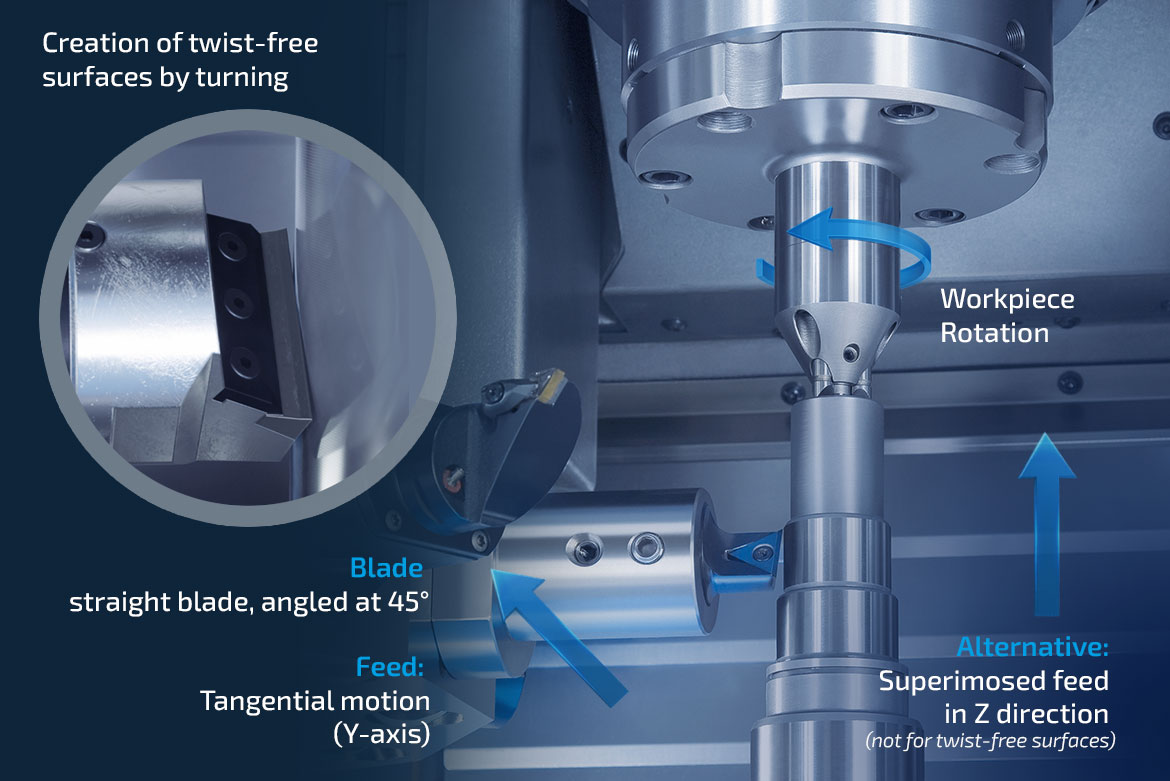
The operating principle: A straight cutting edge set at a 45-degree angle sweeps tangentially past the rotating workpiece. The point of contact moves along the cutting edge.
3. How are twist-free surfaces created in this process?
Since there is no axial feed during scroll free turning, no thread structure is formed on the workpiece in the first place. In addition, the cutting edge, which is set at a 45-degree angle, acts as a smoothing edge: The portion of the cutting edge that follows behind the cutting zone glides over the freshly machined surface and smooths out any remaining roughness peaks in a single pass.
A distinctive feature of this process is that the surface finish of the cutting insert is transferred to the workpiece almost one-to-one, irrespective of the feed rate. EMAG uses two standard cutting inserts in this case. A deliberately rougher variant produces Rz values of 1 to 4 for seal seats, since the radial shaft seal requires an oil cushion – a surface that is too smooth causes the oil film to break. The ultra-fine-ground variant achieves Rz values below 1, for example for bearing seats. Depending on the insert, the helical depth ranges between 0.1 and 0.8 micrometers, and the theoretical flow cross-section is less than 60 or 20 square micrometers, respectively.
The maximum feed rate achievable for turning free of tool marks depends on the diameter: at 35 millimeters, approximately 0.18 mm/rev is possible; at 100 millimeters, up to about 0.5 mm/rev. If free of tool marks is not required, feed rates of up to 1.5 mm/rev are realistic.
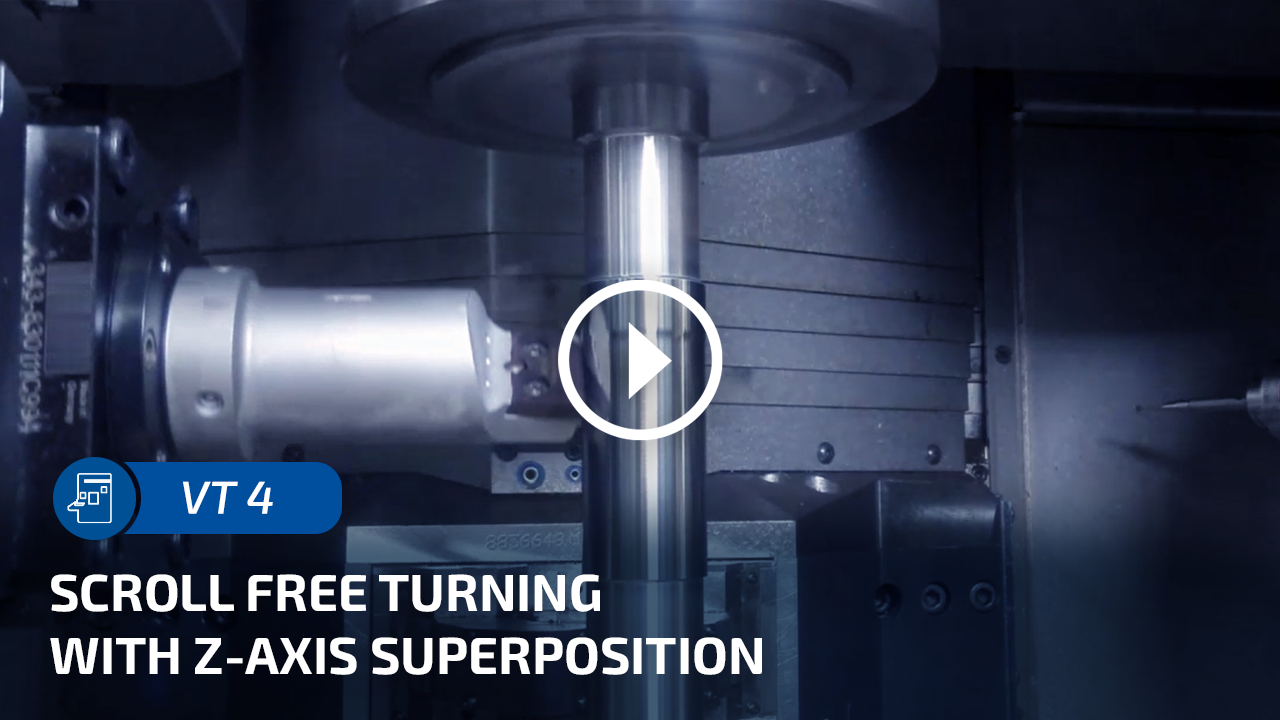
Soft machining with superimposed Z-axis movement: This allows even long diameters, such as the laminated core, to be finished-machined very quickly—with feed rates of up to 1.5 mm per revolution.
4. Where is Scroll free turning used – in hard or soft machining?
Both. In hard machining, scroll free turning is a fast alternative to grinding seal and bearing seats on hardened shafts – achieving Rz values of 1 to 4, roundness tolerances under 5 micrometers, and cylindricity deviations under 8 micrometers. In soft machining, it demonstrates its strengths, for example, on the laminated core of rotor shafts: Instead of finishing at around 0.2 mm/rev, the process is performed at 1 mm/rev or more. In a practical example, this reduces the machining time for the rotor core from 22.7 to 6.1 seconds.
The process also handles interrupted cuts – such as those across tooth profiles or feather key grooves – significantly better than conventional turning, thanks to the gentle entry and exit of the cutting edge. Tool life ranges from 2,000 to 12,000 components, depending on the material, cutting speed, and tool life criteria. “The scroll free turning cutting edge smooths out over its service life – so the surface finish tends to get better and better. In fact, a common criterion for service life is that the surface eventually becomes too smooth,” explains Jannik Röttger, a scroll free turning specialist in EMAG’s Technology Development department. Consistent input quality is important for stable results; in practice, therefore, parts are usually pre-turned using conventional methods.
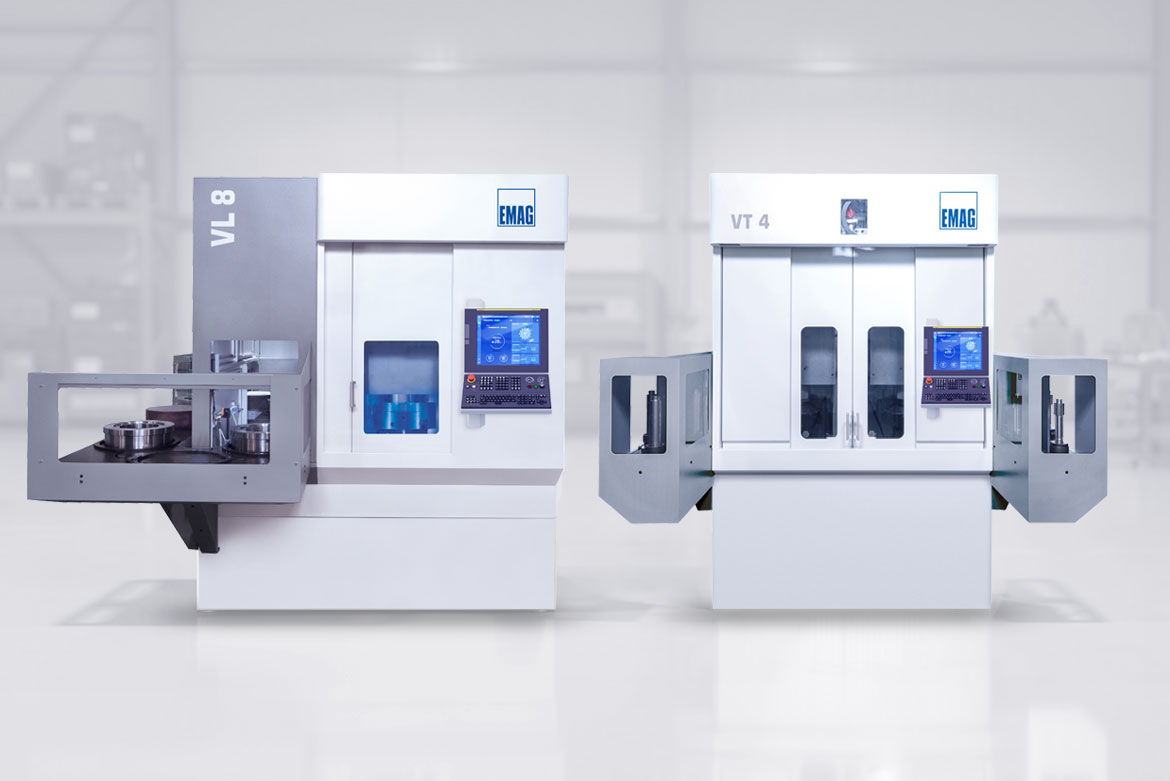
Scroll free turning in series production: the vertical shaft turning machines of the VT series and – for flange-shaped components – the VL series chuck machines from EMAG.
5. What machines and requirements are needed for this process?
Scroll free turning requires a lathe with a Y-axis or a swiveling turret and – due to the comparatively high radial forces – a stable workpiece clamping system, such as a collet chuck or the EMAG shaft chuck, supplemented by a steady rest if necessary. At EMAG, the process is primarily used on the vertical shaft lathes of the VT series; for flange-shaped components, it is also used on the VL series.
No specialists are required at the machine: A specially developed EMAG peeling cycle handles the calculation of movements in the background. The machine setter simply enters parameters such as diameter, feed rate, and cutting speed and adjusts the tool as in normal turning operations – a CAM system is not required. Limitations: The process is designed for O/D (Outer Diameter); I/D (Inner Diameter) and end faces are not possible.
Conclusion: Scroll free turning combines the surface quality of grinding with the speed and flexibility of turning – dry, with low investment costs and long tool life.