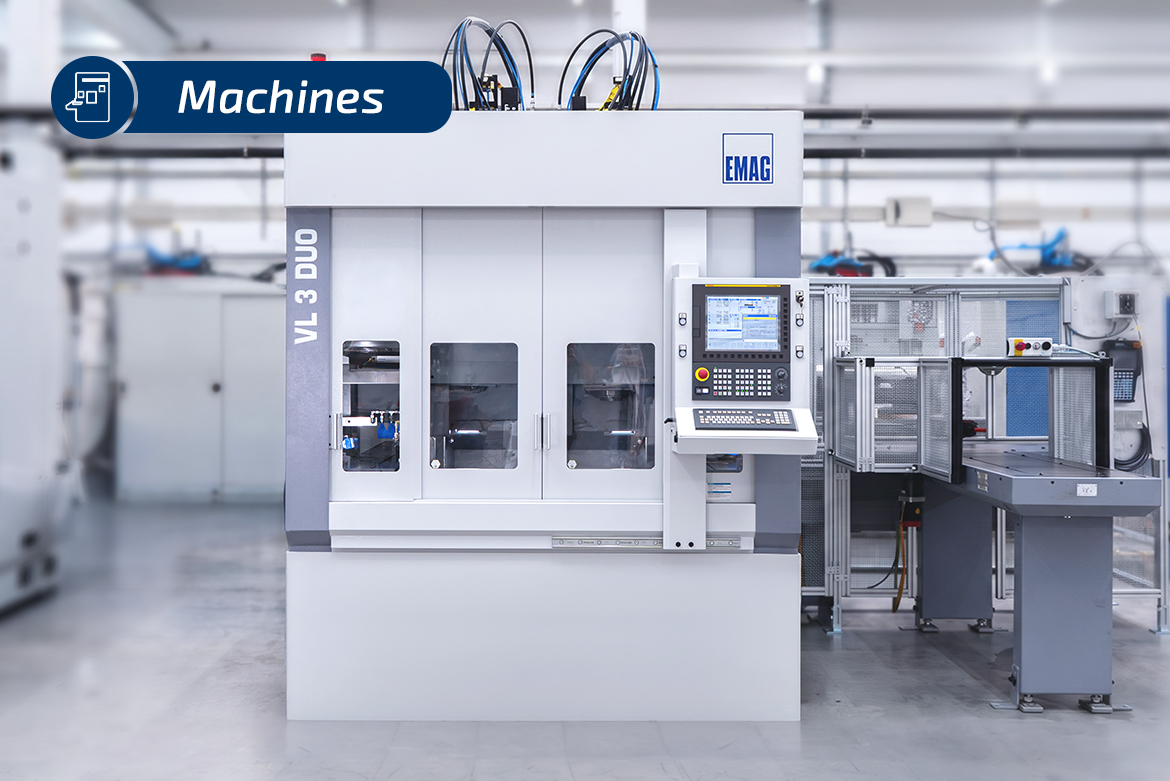
Skilled labor shortages, cost pressures, and limited floor space are challenges every manufacturer faces. For high-volume production of chucked components, that means getting more parts out of every shift and every square meter. This is where EMAG’s VL 3 DUO comes in. The dual-spindle turning machine combines two work spindles and integrates pick-up automation with TrackMotion and a parts magazine in just 24.5 m². This article highlights the benefits this offers.
Vertical pick-up principle: The machine loads itself
EMAG introduced the first vertical pick-up turning machine to the market in 1992. The principle is simple: The work spindle has a dual function. It picks up the raw-part, machines it, and sets the finished part down again. That makes automation an integral part of the machine concept, eliminating the need for a loading hatch, automatic front door, or gantry loader. The vertical design also improves chip evacuation. And because a parts magazine keeps raw-parts ready, an operator can run multiple machines and handle measurement tasks regardless of cycle time. According to EMAG, productivity is typically 10 to 15 percent higher than that of horizontal lathes without integrated automation.
Twin-Spindle Lathe in DUO or TWIN Mode
At the heart of the VL 3 DUO are two mirror-image work areas. Each features its own pick-up spindle with 17.9 kW and 144 Nm, as well as a 12-station turret. Driven tools and a Y–axis are available as options. For high chip capacity, a high-torque spindle with 32.4 kW and 255 Nm is also available (values at 40% duty cycle). The machine handles chucked components up to 150 mm in diameter.
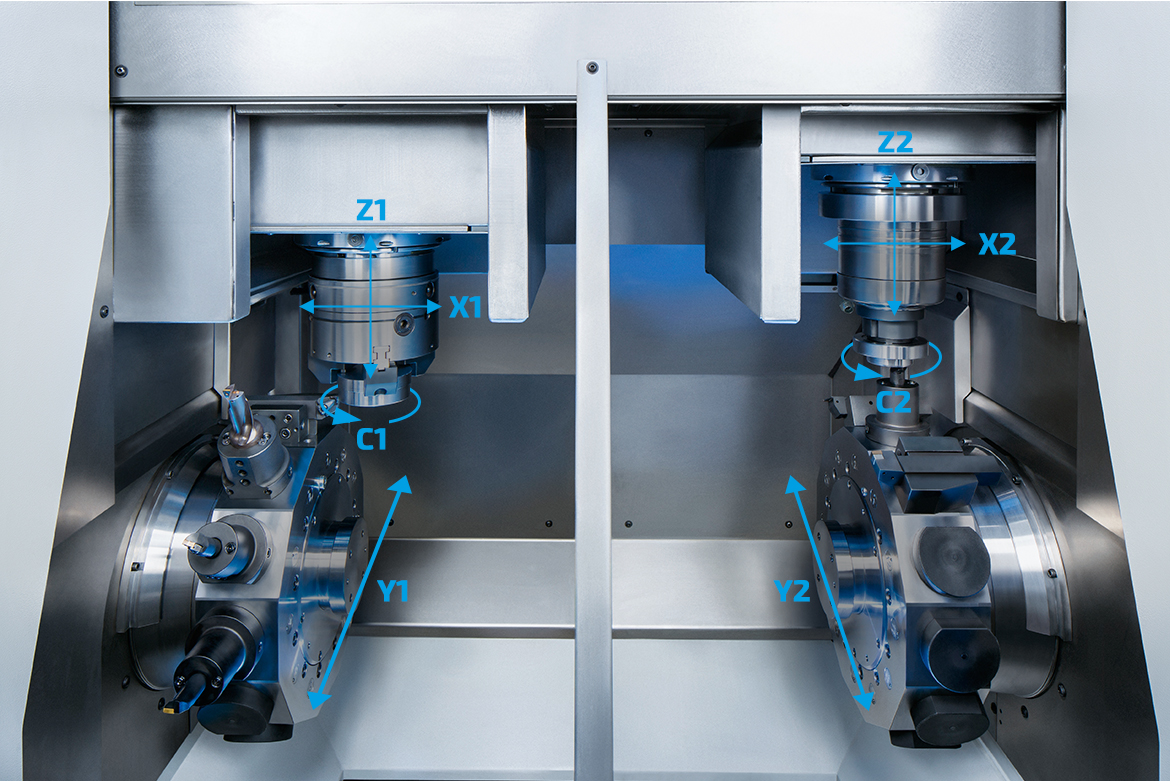
Mirrored configuration: Each work area has its own pick-up spindle and turret.
Depending on the task, the machine operates according to one of two principles:
- DUO principle (OP 10/OP 20): One work area machines the first side of the workpiece, and the other machines the second. Parts leave the machine fully turned.
- TWIN principle (OP 10/OP 10): Both work areas machine the same component, doubling output.
Both spindles are mounted on a common machine base made of Mineralit®. FEM-optimized structures and vibration-decoupled work areas reduce vibration transfer between the spindles so much that it isn’t noticeable during machining.
TrackMotion: Transport and Turning in a Single System
Optionally, TrackMotion – the automation system developed in-house by EMAG – handles workpiece transport. In the automation aisle behind the work areas, the TransLift – a lifting and turning cart equipped with a programmable electric gripper – travels along a rail. It transports the raw-parts from the parts magazine to the machine, turns the workpieces between OP 10 and OP 20, and returns the finished parts. Only one component is moved at a time – an advantage for parts management.
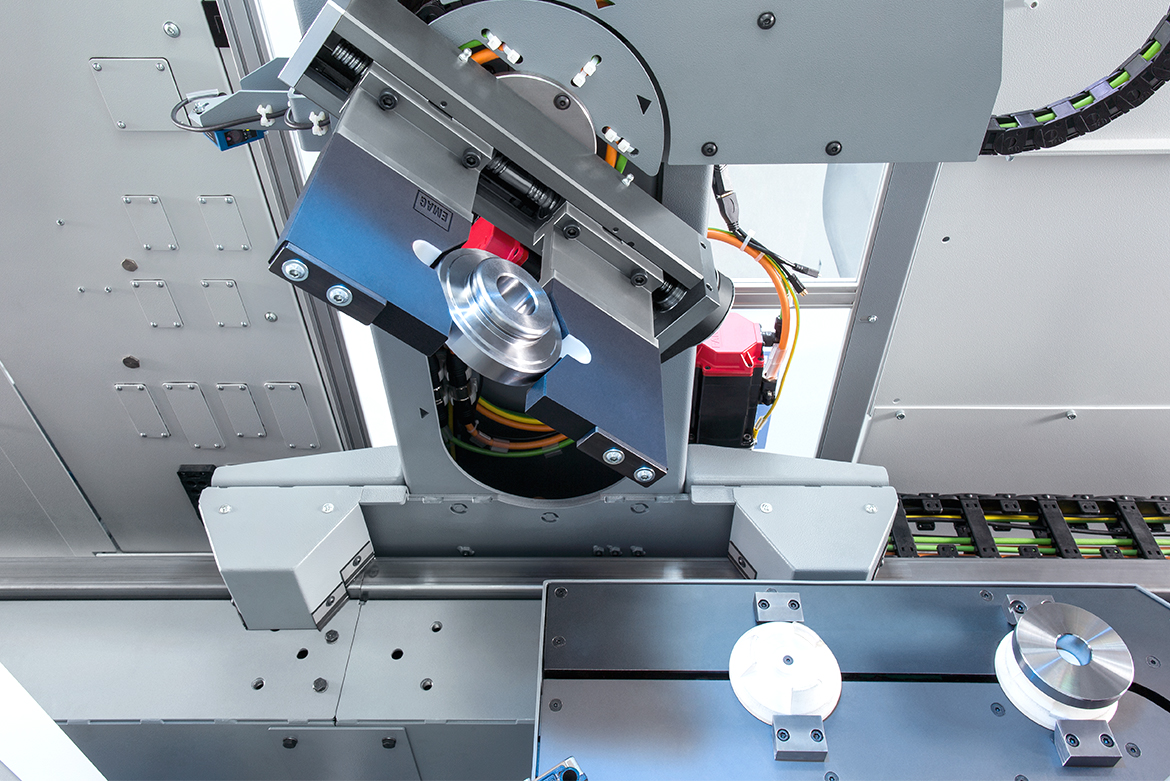
The TransLift grips the workpiece and flips it for machining the second side.
TrackMotion doesn’t need its own electrical cabinet or controller. A four-channel controller manages both spindles, the TransLift and the parts magazine. This minimizes costs and simplifies setup. And because productivity is higher, energy consumption per part drops.
Batch Production: Labor-Saving and Scalable
Depending on the workpiece geometry, the parts magazine can hold up to 400 components. This allows the VL 3 DUO to operate autonomously for a period of time, making it ideal for low-labor production. Furthermore, the dual-spindle lathe can be flexibly expanded.
- Robot cells with a double-L shuttle, for example with a measuring station and NIO discharge
- Bin Picking: A robot equipped with a 3D camera retrieves the raw-parts directly from the bin.
- Link-up with additional VL machines via TrackMotion, shuttles, or gantries—even retroactively, since the automation aisle is always available.
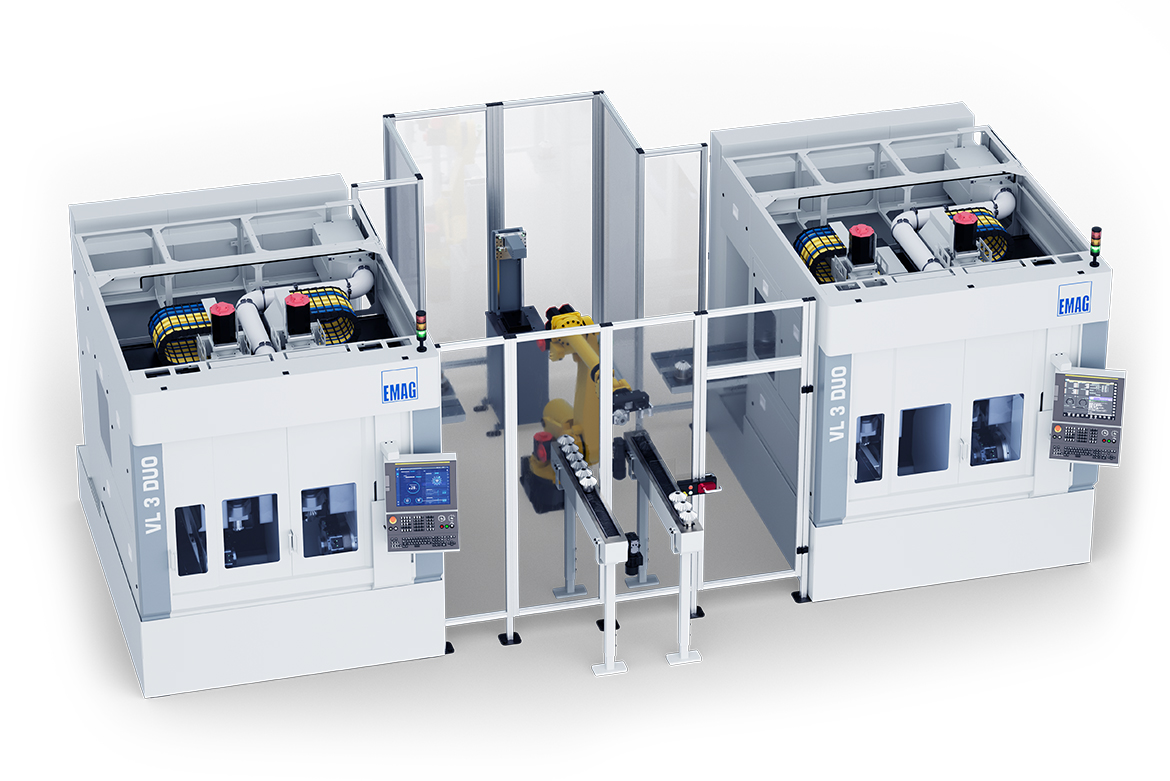
Two VL 3 DUO robots with a double-L shuttle form a compact manufacturing cell together with a robot.
Easy setup, easy access
Despite the compact design, the turrets and work spindles are within easy reach. There’s no need to shut down the entire machine for minor interventions. For example, an operator can change an indexable insert in one work area while the other keeps running. In the bevel gear production line, one VL 3 DUO continues production while the second is being set up. Part families can be designed from the outset so that changeovers to slightly different geometries are quick. EMAG can also supply chucks and tools upon request.
Additional advantages at a glance
- Precision: Machine base made of Mineralit® with approximately ten times higher damping than cast iron, 10 t machine weight, roller recirculating guides, and direct position measurement systems on all axes
- Thermal stability: Water-cooled motor spindles
- Footprint: 24.5 m² for the complete system, including TrackMotion, parts magazine, and chip conveyor
- IoT-Ready: Sensory equipment and EDNA Health Check Support Predictive Servicing
- Everything from a single source: EMAG develops and manufactures spindles, turrets, compound slides, and TrackMotion in-house
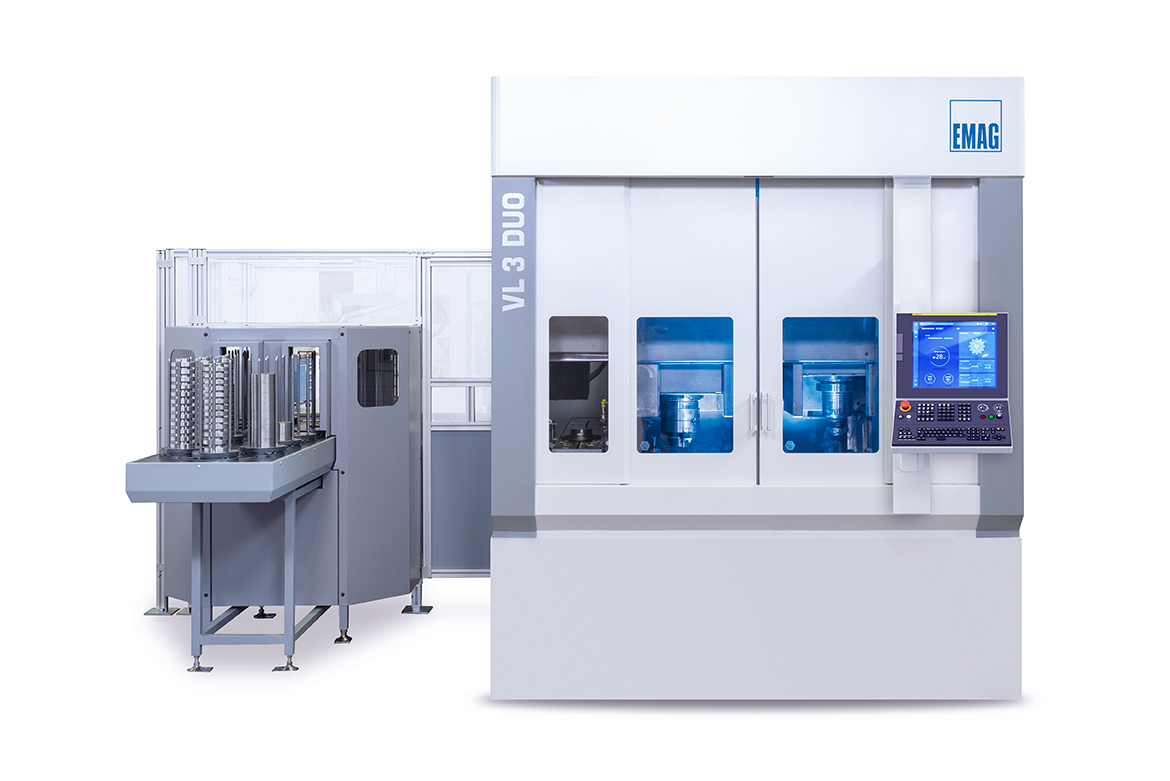
The VL 3 DUO with a parts magazine for up to 400 workpieces and TrackMotion
Proven in practice
The VL 3 DUO is one of the most successful machines in the EMAG portfolio. At AccuRounds in the U.S., it operates – combined with a robotic arm and a drawer system – at times without supervision. PENN GmbH in Austria uses numerous VL 3 DUO and VL 2 machines with TrackMotion for machining in OP 10 and OP 20 – operating on a 20-shift schedule for most of the year. And at the Czech supplier ZLKL, the VL 3 DUO is one of approximately 25 EMAG machines that together produce about 300,000 components per month.
Conclusion: Two spindles, one well-designed system
The VL 3 DUO demonstrates just how productive a small footprint can be: Two work spindles and a pick-up automation system work together seamlessly. As an option, TrackMotion handles transport and turning of the components. Whether as a standalone machine with a parts magazine or as part of a link-up of production lines – the dual-spindle turning machine is designed for cost-effective batch production of chucked components.