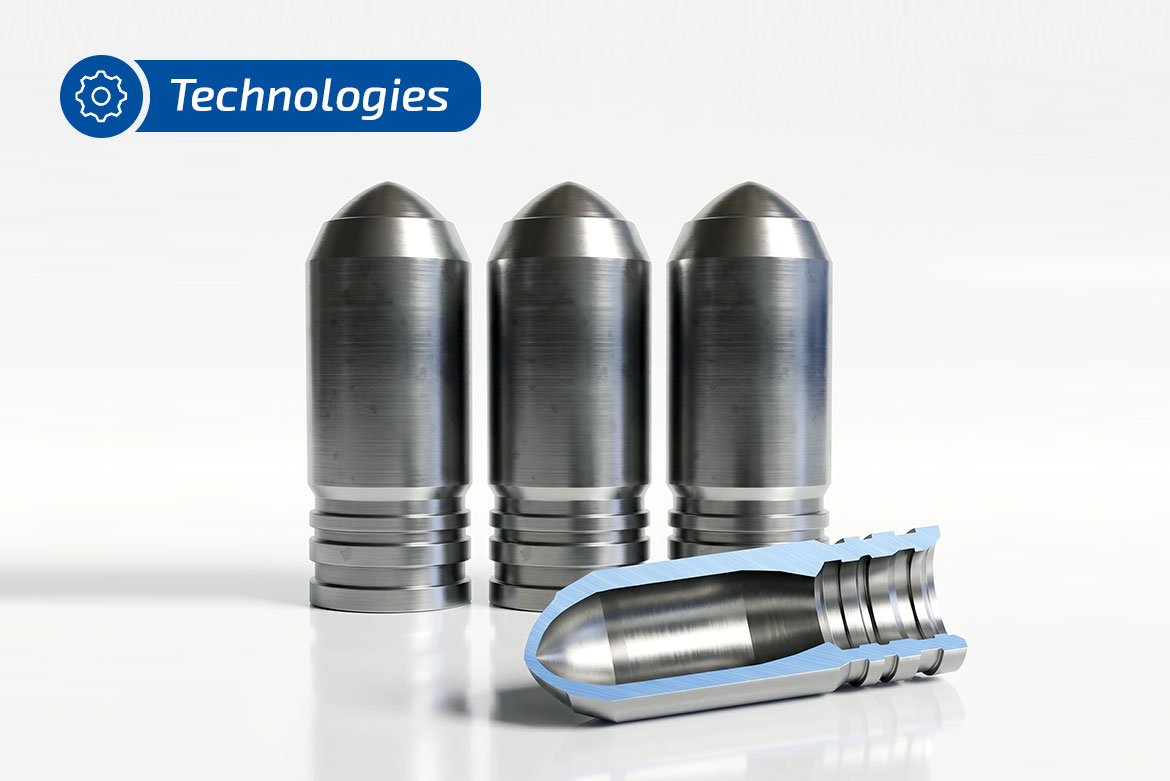
EMAG has developed a production line concept for 120mm tank ammunition built around the VL 8 vertical pick-up turning machine. The projectile body is machined from solid stock in three operations, starting with drilling and internal turning, moving to external machining, and finishing with threads and undercuts. This article describes the workpiece, the machine, the process sequence, line design, and automation, and the results of the machining tests.
The workpiece: Projectile body made of high-strength steel
EMAG offers complete manufacturing systems for 120mm armor-piercing ammunition, 120mm mortar rounds, and 155mm artillery shells, among other workpieces. The projectile body is a rotationally symmetric component 300 to 400 mm long, with an ogival tip and external thread, a thin-walled cavity, and a base section with an internal thread and several undercuts. The raw-part is typically a section cut from solid material. Forged or cast blanks with a preformed cavity are currently the exception. That means the entire internal contour has to be drilled from solid material and then turned out. The material adds another challenge: high-strength steel that doesn’t break chips well. High chip volume and poor chip breaking determine the machine and process design.
Vertical Design: Chips fall out of the component
Drilling from solid stock and turning generate a large chip volume inside a cavity that is closed on one side. In a vertical lathe, the workpiece is suspended in the pick-up spindle with the opening facing down, so the chips fall straight into the chip conveyor. On a horizontal machine, chips would stay inside the bore. That would require an additional blow-out station, and chip clusters could still damage surfaces and tools.
The pick-up principle is another advantage: The work spindle picks up the workpiece from the integrated conveyor belt and sets it back down after machining, making automation an integral part of the machine. EMAG systems also produce 120mm mortar ammunition on the same principle, with a VT 4 for OP 10 and a VL 8 for OP 20.
The Machine: VL 8
The VL 8 is used here – the largest machine in EMAG’s modular vertical turning machine series for chucked components. Key specifications:
- Workpiece dia. up to 400 mm, chuck dia. up to 500 mm, swing dia. 520 mm
- Main spindle: 47.5 kW and 780 Nm at 40% duty cycle, 34.5 kW and 600 Nm at 100% duty cycle, maximum 2,850 min⁻¹
- X-axis travel: 1,110 mm, Z-axis travel: 595 mm; optional Y-axis travel ±30 mm
- 12-position turret, optionally with powered tools
- Machine base made of Mineralit polymer concrete with high vibration damping
The machine base’s vibration damping improves surface finish and tool life on high-strength materials. And the pick-up principle with integrated workpiece storage keeps non-cutting time between machining operations short.
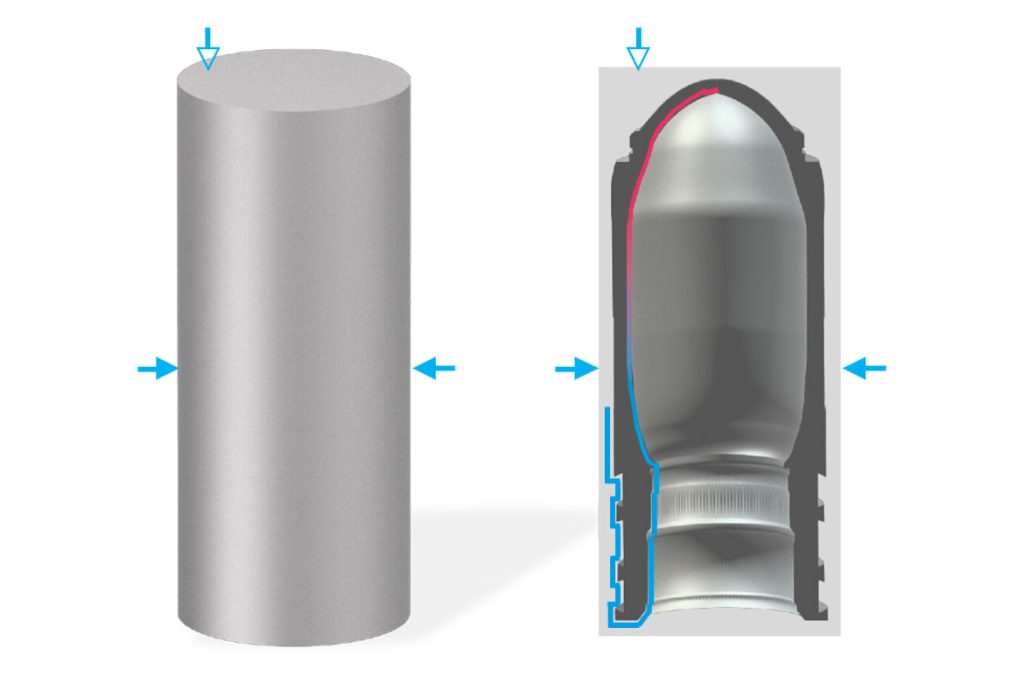
Process plan OP 10 on the VL 8: Solid raw-part (left) and machined workpiece (right) with drilled and turned internal contour as well as rough-machined bottom area (red).
Three operations, three setups
- OP 10 – Drilling and Internal Turning: The raw-part is clamped at what will later be the head end. The internal contour is first drilled from solid, then rough-turned into a preliminary contour, giving the cavity an egg shape. In the same setup, the base area is rough-machined both internally and externally. OP 10 is the operation with the largest material removal volume and the longest cycle time.
- OP 20 – External Contours: The workpiece is rotated 180 degrees and clamped at the pre-turned base. This operation mahcines the body diameter, the ogive, and the external thread at the head.
- OP 30 – Finishing: The workpiece returns to its OP 10 orientation. The outer diameter (OD)and iInner diameter (ID) at the base are finished, including the outer clearance cuts and the internal thread.
Rough-machining in OP 10 and finish-machining in OP 30 are kept separate for quality reasons: The required tolerances on diameters, threads, and clearances can only be held reliably in a separate finish-machining operation after external machining.
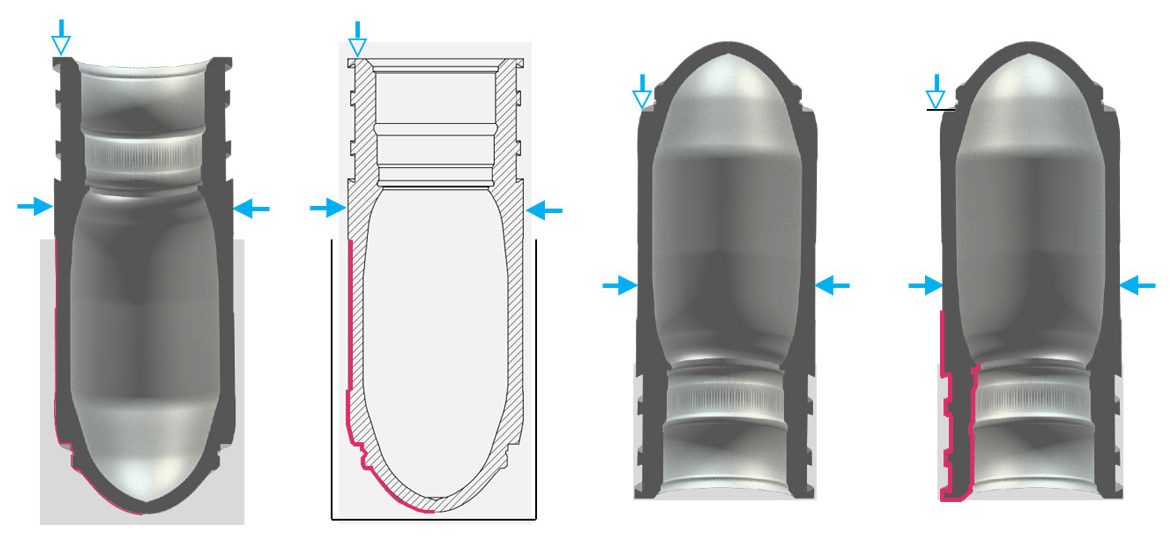
Left: OP 20: Workpiece rotated 180 degrees; machining of external contours, ogive, and external thread. Right: OP 30: Finishing of the bottom, undercuts, and internal thread (red).
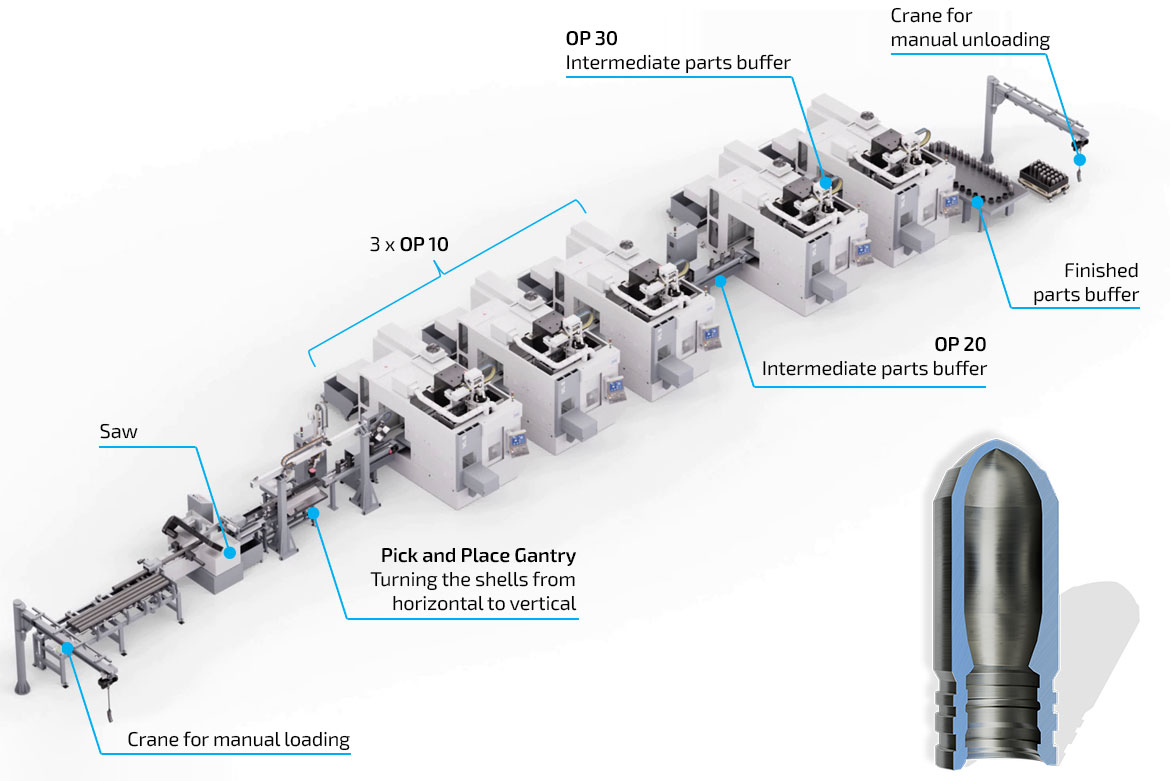
Line design: Five machines for three operations
Balanced cycle times are crucial for the layout. OP 10 takes about three times as long as OP 20 or OP 30. To keep any machine from sitting idle, three VL 8s run OP 10 in parallel, with one each in OP 20 and OP 30—a coordinated system of five machines. If a forged or cast blank with a preformed cavity is available, OP 10 machining volume drops significantly, so two machines, or even one, are sufficient there. The concept also scales in both directions: from compact configurations with a few manually loaded machines for small batches to high-volume production solutions with 20 machines across four production cells. The line also integrates part cleaning, centralized raw part feeding and finished part storage.
Material Flow and Automation
At the start of the line, bars are manually loaded by crane and cut to length on a saw. A gantry loading system orients the sections from horizontal to vertical and transfers them to the TrackMotion system. TrackMotion runs on a rail behind the machines at up to 150 m/min horizontally and 25 m/min vertically. The programmable electric gripper rotates workpieces to change their orientation between OP 10, OP 20, and OP 30.
Intermediate buffers sit between the operations, with a finished-parts buffer at the end of the line where components are removed by crane. The buffers decouple the operations, so the remaining machines keep running if one machine is down for a tool change or a malfunction. This increases output and Overall Equipment Effectiveness (OEE).
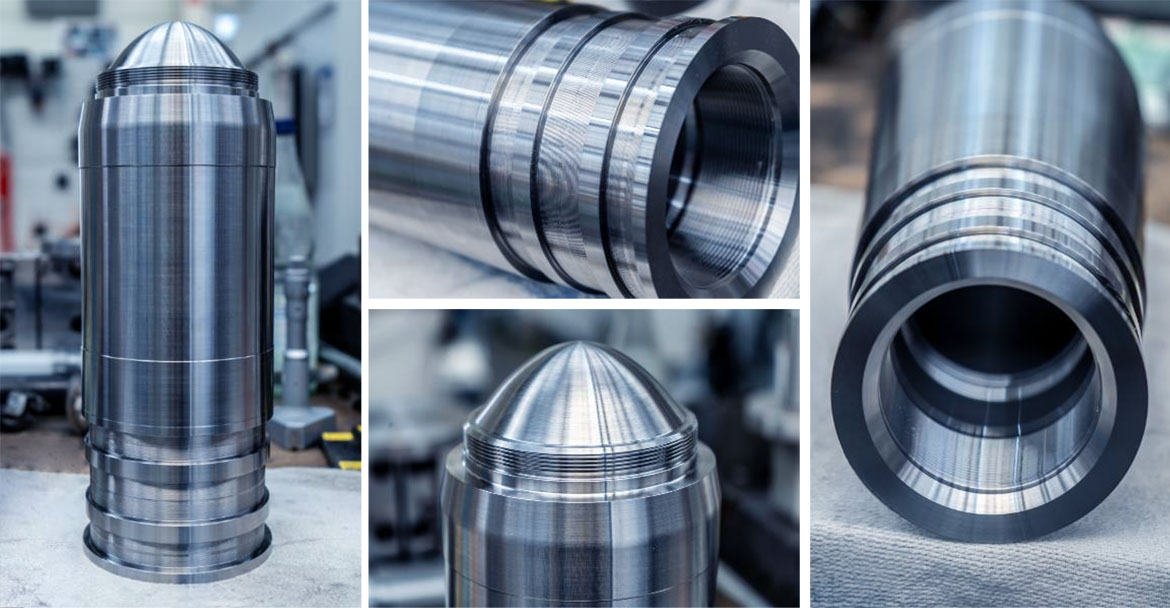
Machined projectile bodies from the tests at EMAG: ogive with external thread, base area with undercuts and internal thread.
Machining Tests: Verified Cutting Parameters
Because the material is very hard and doesn’t break chips well, EMAG ran extensive in-house tests on this component. The tests systematically varied cutting speeds, feed rates, and tools for drilling from solid, internal and external turning, and threading. The result is validated cutting parameters for each operation, so cycle times can be calculated reliably and the required surface finishes achieved.
Complete System from a Single Source
EMAG supplies the line as a complete system, including machines, automation, a saw, a gantry, buffers, and process technology with tools and proven cutting data. The line is sized to the required annual production volume and shift schedule. A cycle time calculation and material flow simulation ensure performance before the system is built. A3D animation lets customers walk through the entire line in advance, so every station and handoff is clear from the planning phase.