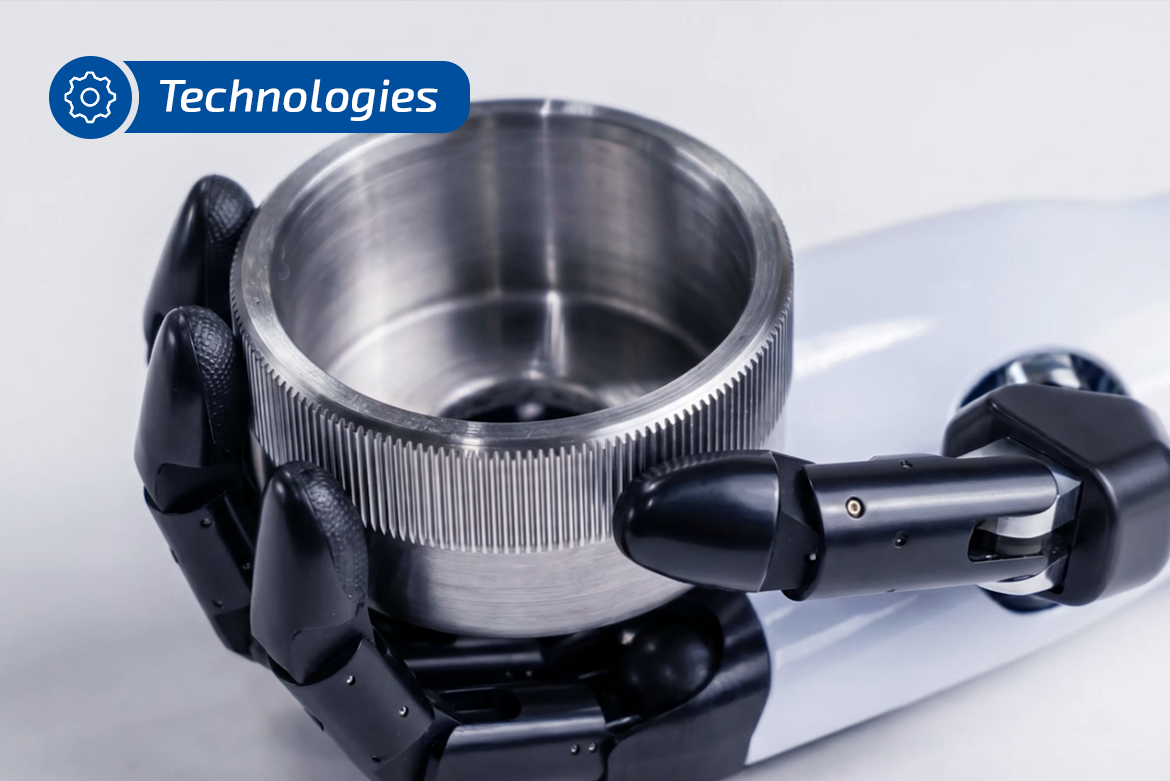
Currently, discussions about humanoid robots focus primarily on software topics: language models, motion planning, and object recognition. Look at these machines from a manufacturing perspective, though, and a different picture emerges. What determines production readiness and scalability isn’t the control system. It’s the mechanics in the joints. More specifically, it’s the actuators and the gearboxes inside them. This article explains how many drive systems are actually installed in a humanoid robot, which gear designs have become standard, and why these components pose the toughest challenge for manufacturing.
Up to 120 drives per robot
Market forecasts for humanoid robots vary widely. In a widely cited scenario analysis, Goldman Sachs Research projects 2035 global sales ranging from 0.7 million units in its bear case to 1.4 million in the base case, 6.5 million in the bull case, and 11.6 million in its blue-sky scenario. Some studies go even higher, at 13-14 million units.
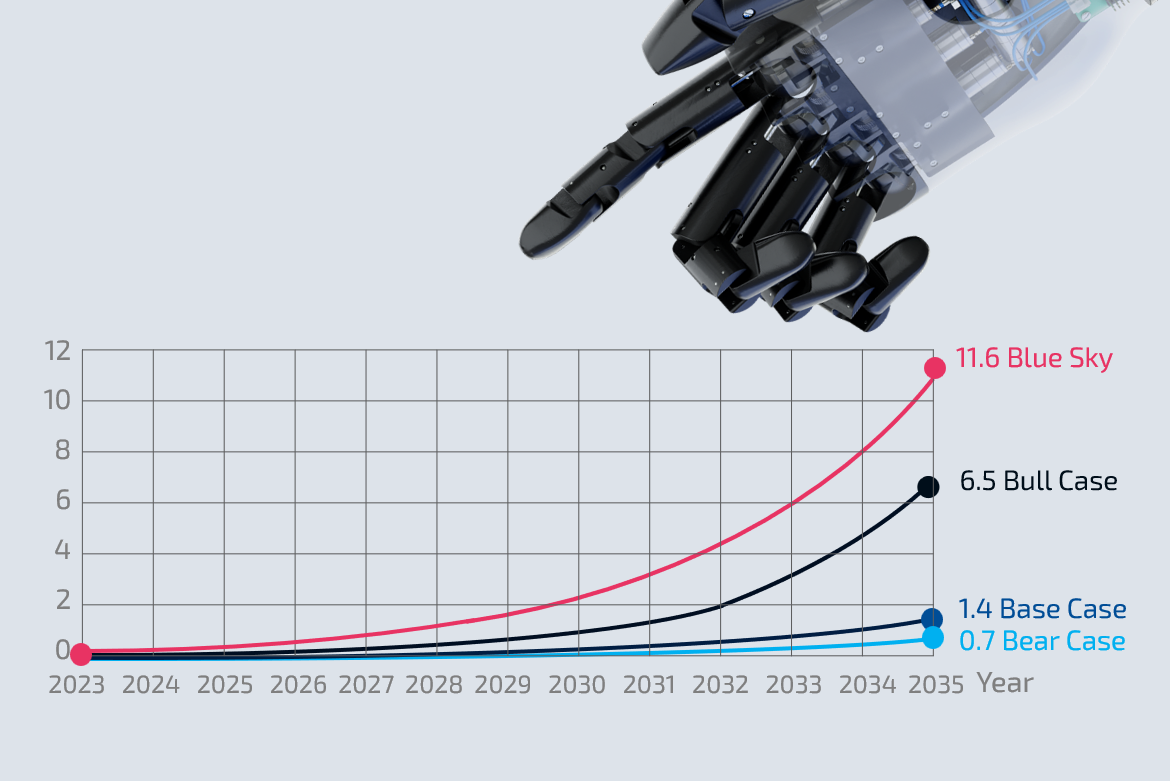
Scenarios for global sales of humanoid robots through 2035. From 0.7 million in the bear case to 11.6 million in the blue-sky scenario. Source of the forecast data: Goldman Sachs Research.
Multiply that range by the bill of materials for a single robot, and it gets interesting. Today, a humanoid robot contains around 60 linear actuators and roughly the same number of rotary actuators. Each actuator contains a gearbox, and each gearbox contains several interlocking components: sun gears, planetary gears, internally toothed housings, shafts, and carriers.
Even a conservative estimate quickly pushes volumes well beyond small-batch production. That’s where automated manufacturing technology comes into play.
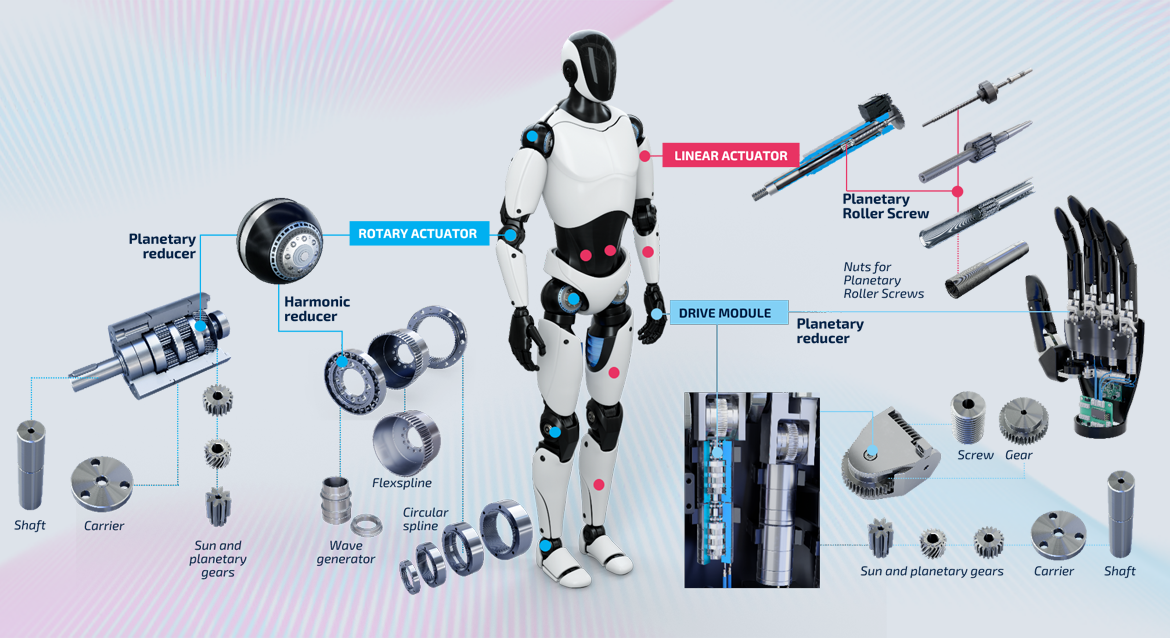
Rotary actuator with planetary and shaft gears, linear actuator, and hand drive module: A single robot contains up to 120 such drives.
Actuators are the muscles of a robot
The term “actuator” refers to a robot’s the motion elements. In biological terms, they act as muscles and joints: They convert electrical energy into mechanical motion, enabling precise, human-like movement.
About 14 rotational actuators are distributed across the major joints. Three sit in the shoulder joint alone, because the shoulder needs a particularly large number of degrees of freedom. There is one rotational actuator each in the elbow and knee, and two are installed in the hip joints to enable both flexion and rotation.
The hand is where the demands become most evident. The thumb alone requires two drive mechanisms because it needs more degrees of freedom than the other fingers. Each finger has its own gearbox. A hollow-shaft motor transmits the rotational motion to a multi-stage planetary gearset, which reduces speed and increases torque. The fingers close via a worm gear and a cable pull, and torsion springs open them again.
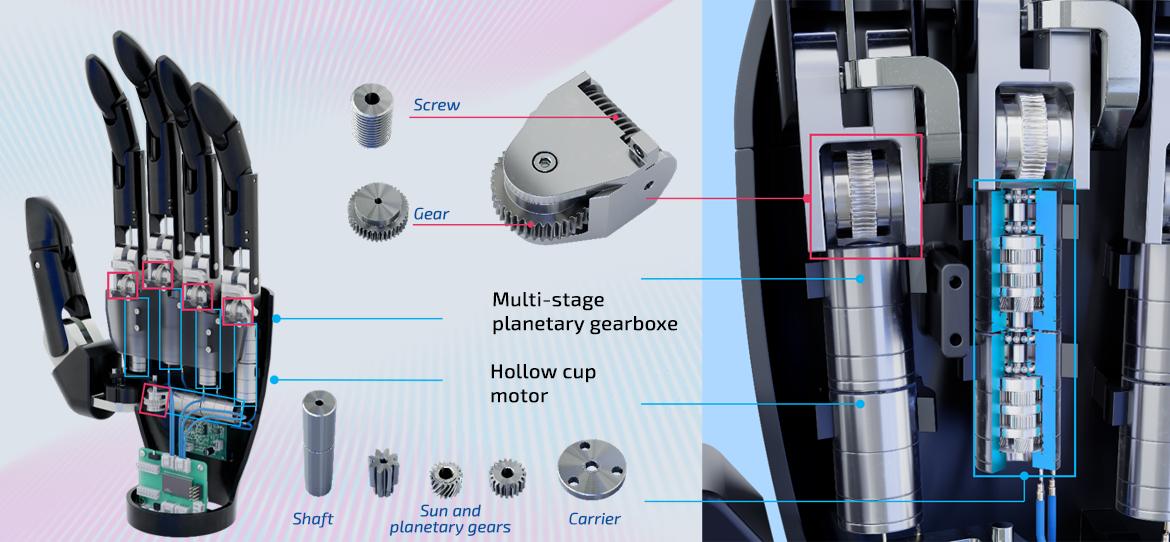
A hollow-shaft motor, a multi-stage planetary gearbox, and a worm gear operate within the hand’s extremely confined space. The thumb alone requires two actuators.
The human hand works reliably for a lifetime and offers enormous mobility and precise force control. Mechanically replicating it is a major challenge that can only be solved with high-precision drives.
Three gear design types dominate
Three types of gear systems have become standard in humanoid robot joints.
The planetary gearset is the central transmission element of rotary actuators. A drive shaft drives the sun gear, which moves the planetary gears; the housing that carries the internal gearing. Depending on the number of gear stages, it can transmit very high torque. Helical gearing is often used in the input stage because it runs quietly and smoothly at high motor speeds.
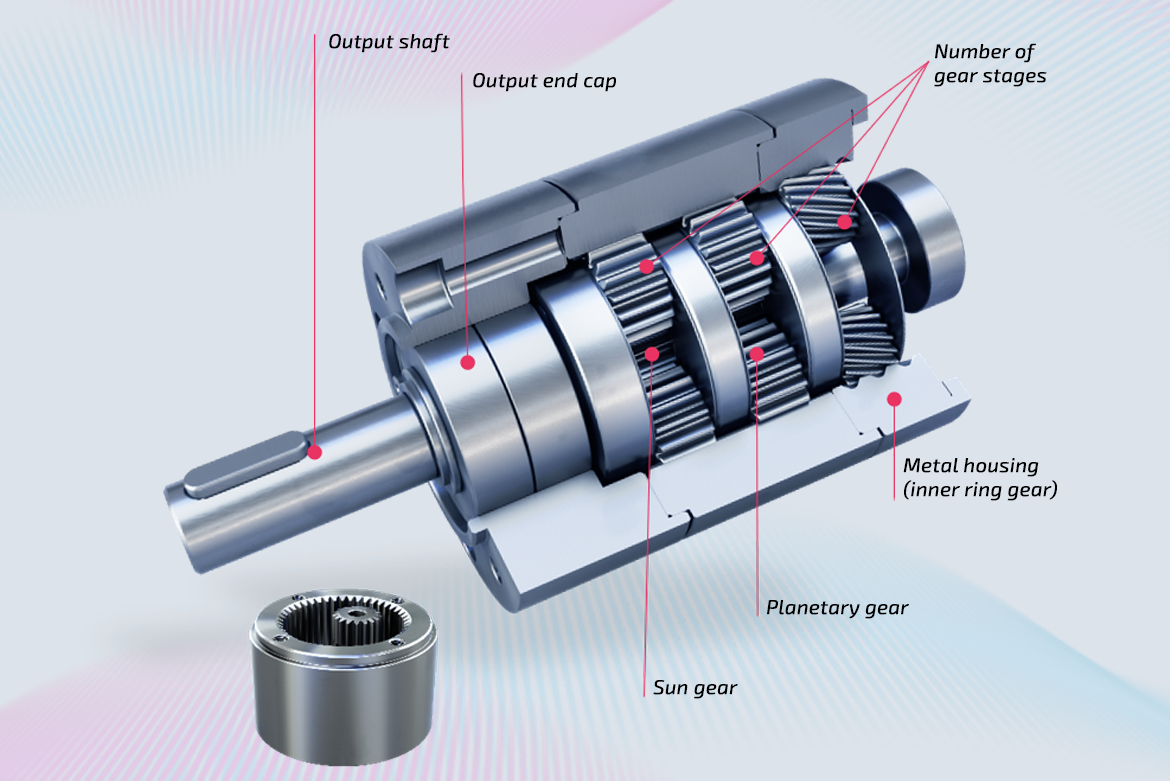
Output shaft, sun gear, planetary gears, and internally toothed housing. The number of gear stages determines the transmissible torque.
The strain wave gear, also known as a harmonic reducer, has three main components: a wave generator, a flexspline, and a circular spline. The flexspline is a thin-walled component built to flex.
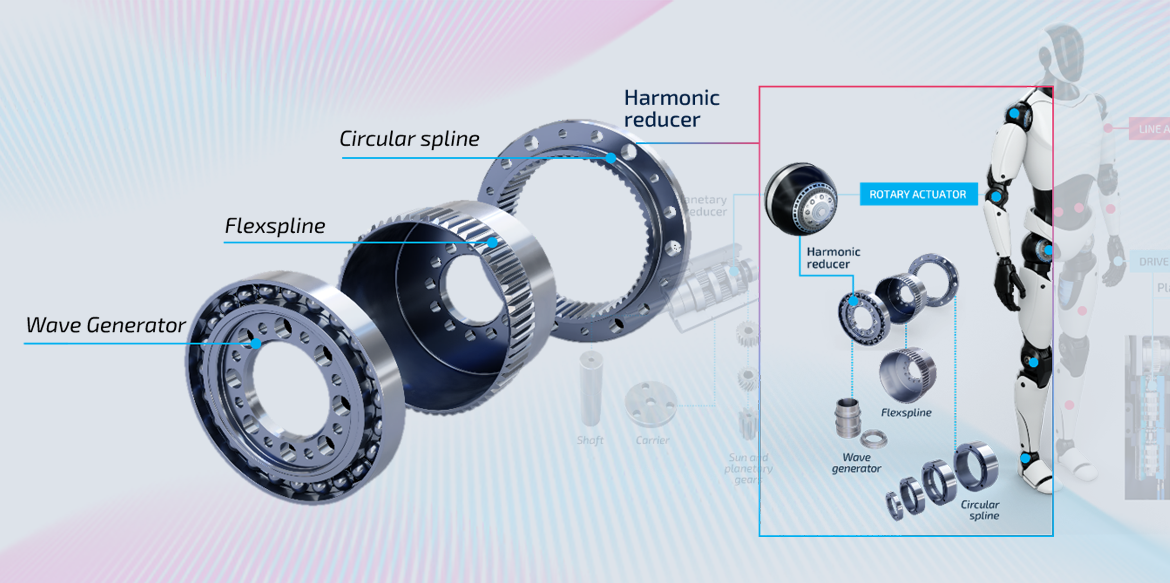
A strain wave gear consists of a wave generator, a flexspline, and a circular spline. In the rotational actuator of a humanoid robot, it is located directly within the joint.
The cycloidal gear operates in two stages. The servomotor’s rotation is transmitted via the drive wheel to a spur gear, which is directly connected to the crankshaft. On the eccentric section of the crankshaft, two RV gears are mounted on needle bearings. They are offset by 180 degrees from each other, which balances the forces.
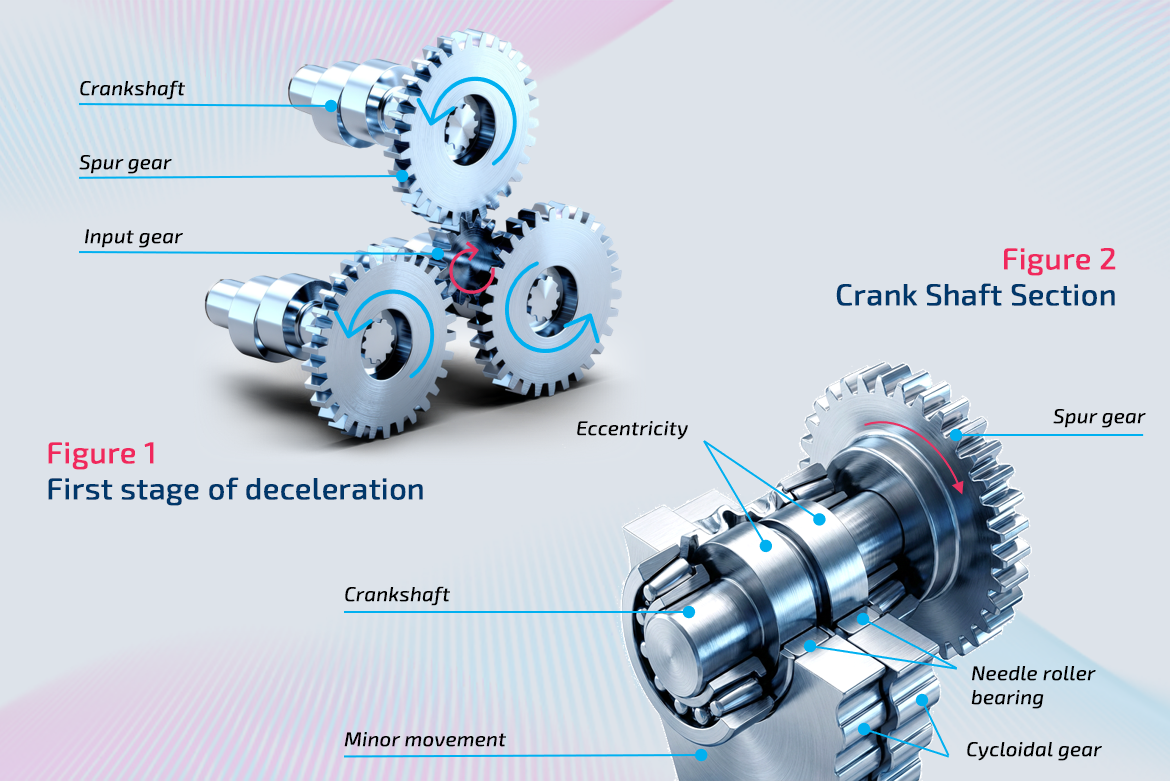
The sun gear drives the crankshafts via the spur gears. In the eccentric section, two RV gears run on needle bearings and produce the reduced motion.
Then, there are the linear drives. Their central element is a roller screw, which, depending on the design, can be a ball screw, a trapezoidal screw, or a roller screw. Small threaded rollers called planetary screws are arranged around it.
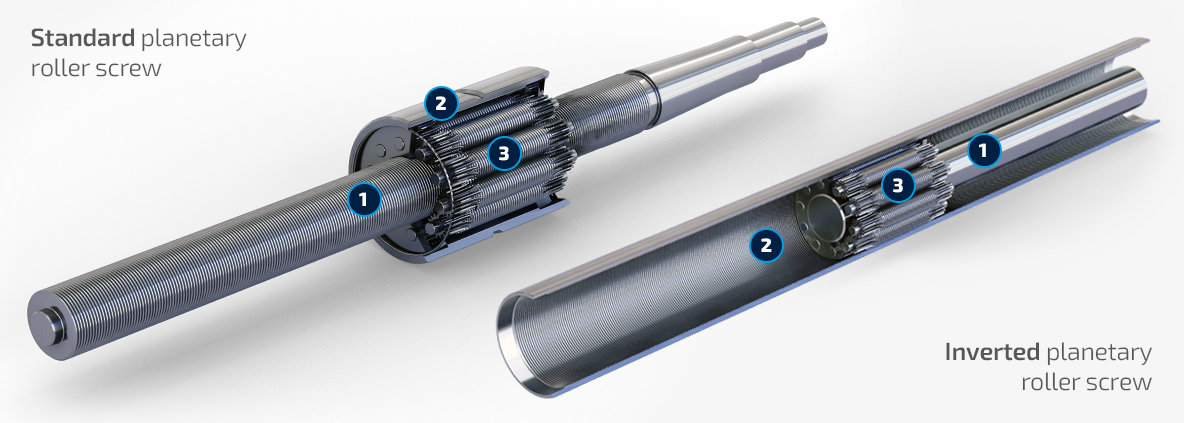
The threaded spindle, nut, and threaded rollers form the planetary roller screw drive. The illustration shows the standard design on the left and the inverted version on the right.
Why the mechanics become the bottleneck
Four factors come into play with these components, and each one would be challenging on its own.
- First, size. The tooth profiles have very small modules. A typical planetary gear in a robot actuator has a standard module of 0.4 millimeters with 24 teeth. A flexspline has a module of 0.3 millimeters with 158 teeth, and its counterpart, the circular spline, goes as small as 0.2 millimeters with 206 teeth. The counterpart always has the same module size.
- Second, quality. The precision and quality of these components directly determines how fast and how accurately a robot moves. Gear quality of DIN 5 or better is required, with values in the DIN 3 range for pitch and concentricity. Results like these are not achieved by the machine alone. They come from the interplay of the process, chuck devices, and reference surfaces from the preceding turning operation.
- Third, material properties. The components are hardened, typically to 56 and 62 HRC, depending on customer requirements. Distortion from heat treatment then has to be corrected through hard machining, which adds a step to an already long process chain.
- Fourth, and the real crux, the leap in production volume. Today, these components are mostly produced as prototypes and in small batches, but forecasts point to significant volume growth in the coming years. Manufacturers starting today with flexible standalone machines will need to produce at high-volume tomorrow, ideally, without overhauling their entire manufacturing strategy.

In our recorded webinar, learn all about the manufacturing of the workpieces that determine the performance of humanoid robots.
From prototype to series production
That’s where the parallel to the automotive industry comes in, an industry EMAG has served for decades: short process times, 24/7 production, and highly automated manufacturing cells. This experience carries over to humanoid drive systems. The difference is that the ramp-up is still ahead, so production has to work both ways: flexible and easy to set up today, highly productive tomorrow.
EMAG’s portfolio covers the entire process chain: turning and grinding technologies, gear hobbing, power skiving, turning and profile grinding, ECM for highly complex geometries, laser processes for welding, texturing, and hardening, plus the automation, measurement, and testing technology to support them.