The internal contour of the pump ring is critical to a vane pump’s smooth operation and efficiency. EMAG’s VL 100 GT grinds it using two grinding spindles in a single setup. A linear motor on the X-axis drives the grinding spindles, tracing the out-of-round contour with low-backlash dynamics.
Pumps usually work out of sight, in cars, tractors, excavators, and heating systems, yet they are indispensable to countless applications.
In vane pumps, one component takes center stage: the pump ring. Its out-of-round inner contour must be ground with the highest precision in both form and surface finish. This article explains how this is achieved with the VL 100 GT and what role the linear motor plays in the process.
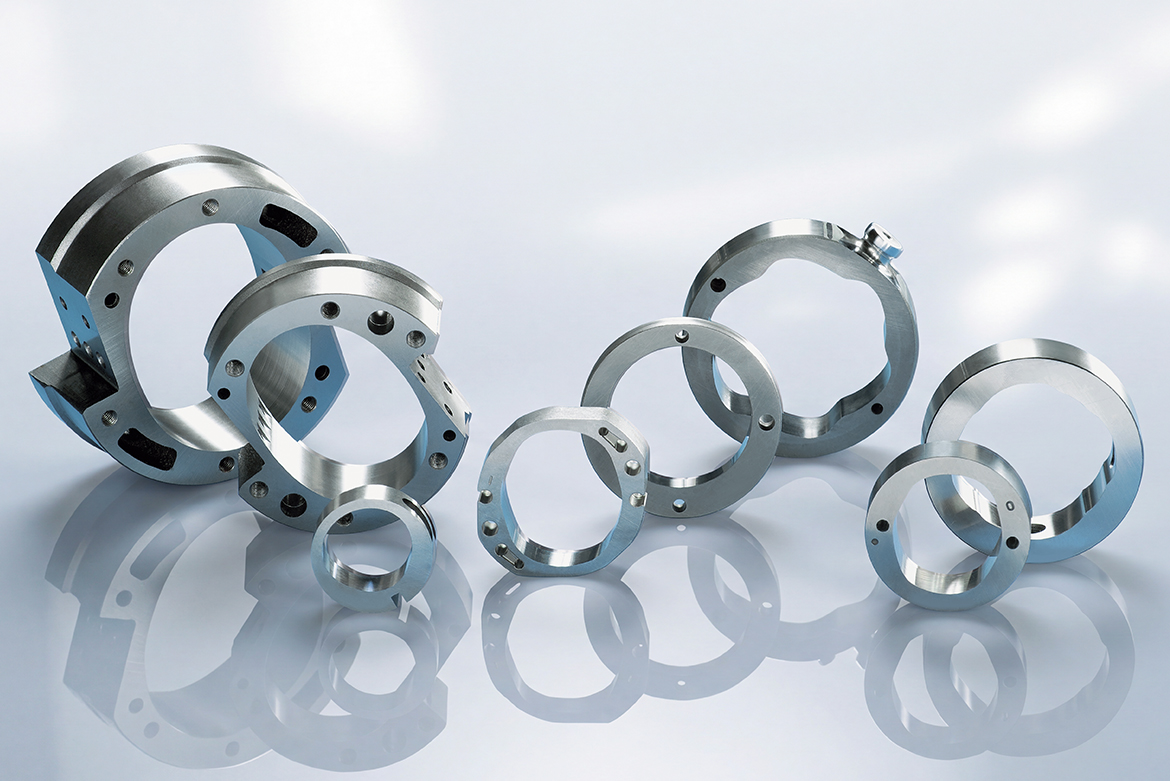
Pump rings in various sizes and designs. Their out-of-round inner contour determines the pump’s smooth operation and efficiency.
Pump Ring: The heart of the vane pump
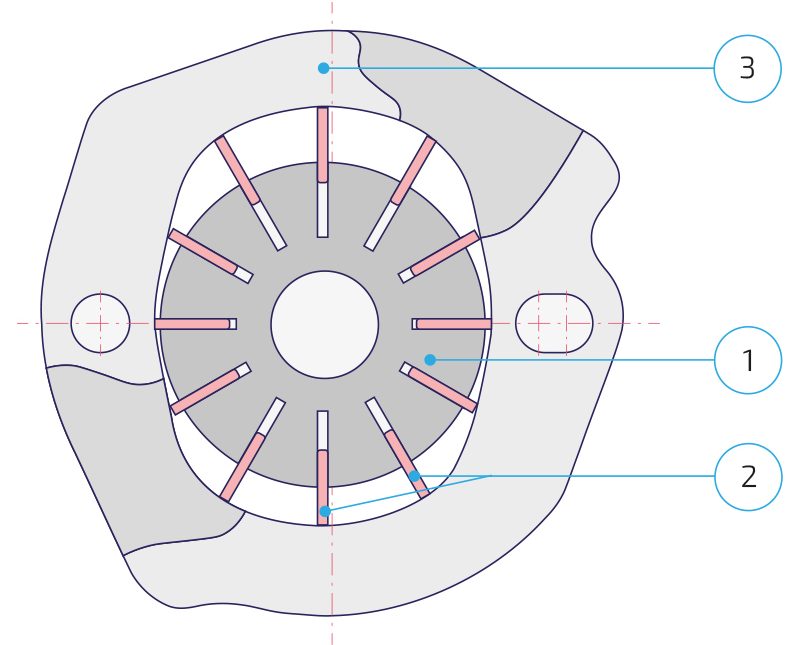
Rotor (1), rotary vanes (2), and pump ring (3): The rotary vanes slide along the inner contour of the pump ring, forming sealed fluid chambers.
In a vane pump, also known as a rotary vane pump, a rotor turns inside the pump ring. Spring-loaded vanes sit in the rotor’s flutes and stay in constant contact with the inner contour of the ring. This creates sealed fluid chambers whose volume changes as the rotor rotates. On the suction side, the chambers expand and draw in fluid; on the discharge side, they contract and pressure builds up, making them ideally suited to hydraulic applications.
The pump ring’s inner contour directly determines the flow rate. Its contour accuracy and surface finish influence smooth operation, efficiency, and wear – and thus the pump’s environmental footprint over its entire life cycle.
The Challenge: Significant allowance, ultra-fine surface finish
In this application example, the inner contour of a pump ring for a two-stage vane pump is ground. The material is either hardened 100Cr6 rolling bearing steel or the sintered material D32. The grinding allowance is 0.8 mm on the diameter, yet a center surface roughness of Ra < 0.2 µm is required.
In addition, there is a maximum profile deviation of 20 µm, a straightness tolerance of 2 µm, a perpendicularity tolerance of 7 µm relative to the end faces B, and a positional tolerance of 50 µm.
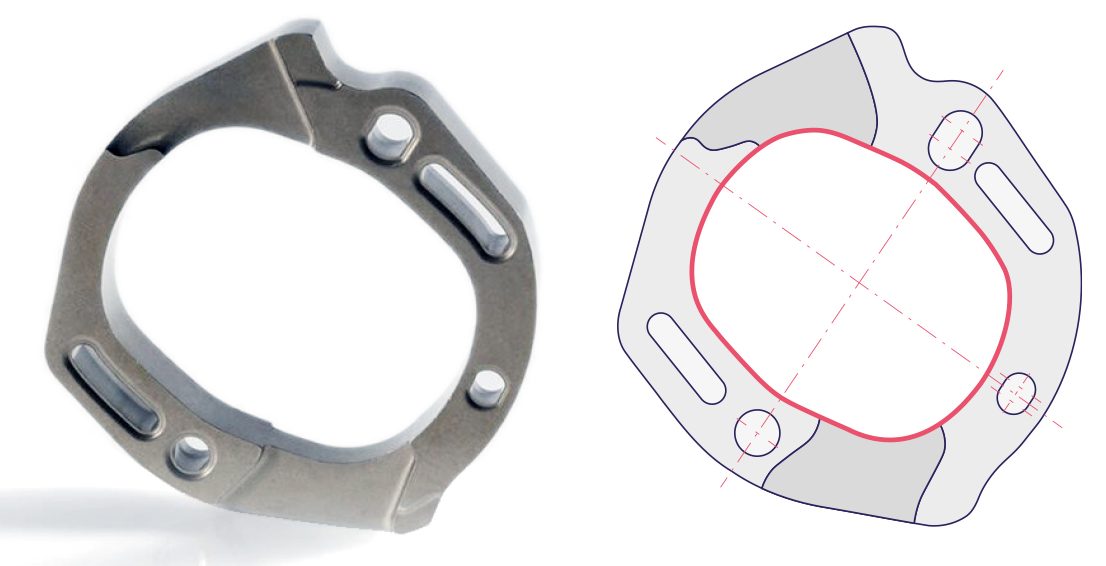
The inner contour of the pump ring, marked in red, is subjected to out-of-round grinding in two stages on the VL 100 GT.
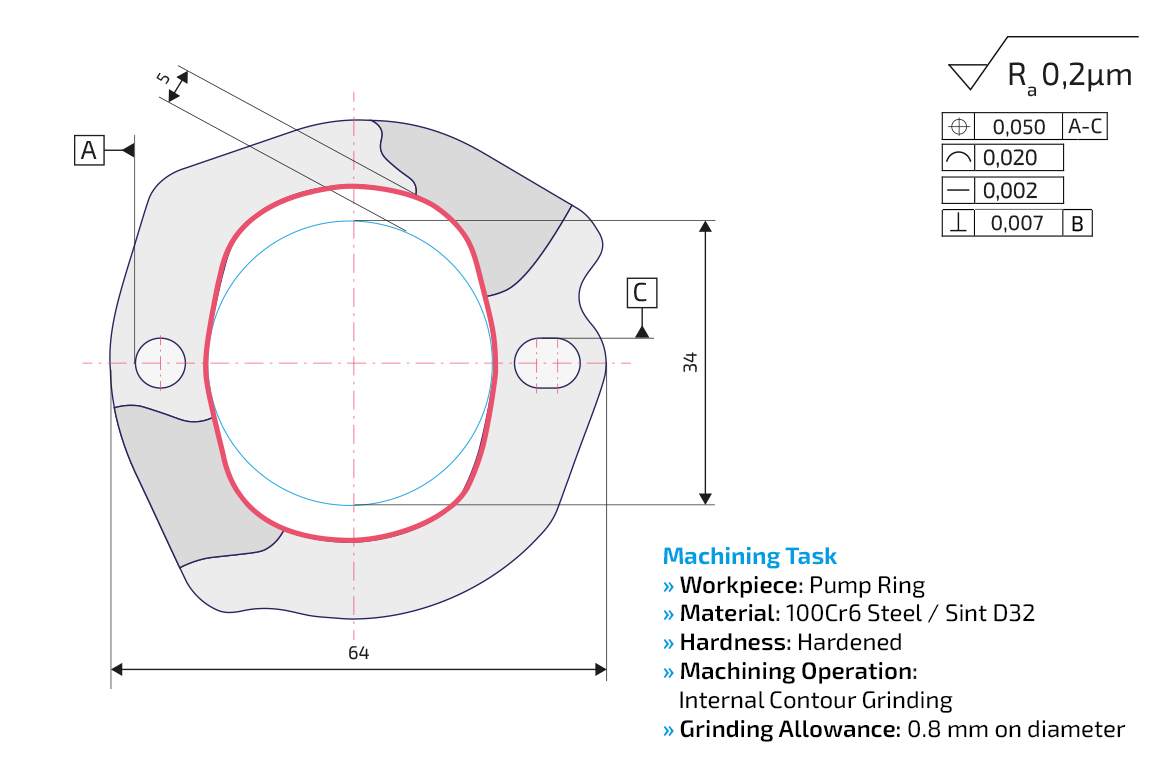
Hardened 100Cr6 or Sint D32, 0.8 mm grinding allowance on the diameter, and a surface finish of Ra < 0.2 µm
VL 100 GT: Pick-up machine with two grinding spindles
The VL 100 GT is a vertical turning and grinding center for chucked components up to 100 mm in diameter. At 64 mm OD, the pump ring fits easily into the work area. For out-of-round machining, the machine has two grinding spindles: one for rough grinding and one for finish grinding.
The pick-up spindle retrieves the raw-part directly from the feed conveyor, clamps it in a face chuck, and moves it into the work area. No separate loader is needed, because automation is integrated into the machine concept. The MINERALIT® machine base dampens vibrations eight times more effectively than cast iron, laying the groundwork for high surface finishes and long tool life. The vertical design lets chips and grinding slurry fall freely downward.
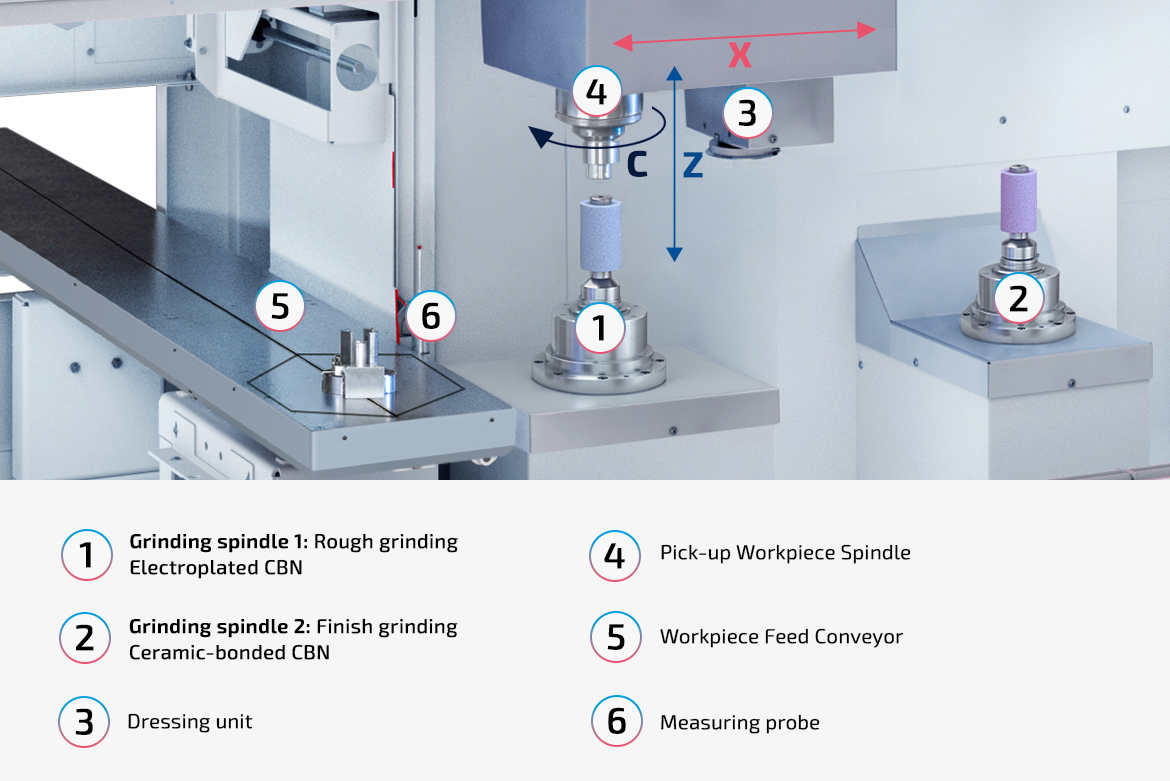
Pick-up spindle with a linear motor on the X-axis, two grinding spindles for rough and finish grinding, dressing unit, and measuring probe
Linear motor on the X-axis: The key to an out-of-round contour
An out-of-round contour is created by interpolating two axes. The C-axis rotates the workpiece, while the X-axis moves the workpiece spindle relative to the grinding wheel. For a pump ring, that means the X-axis must accelerate, decelerate, and reverse direction multiple times per revolution, adding up to thousands of reversals during the grinding process.
That’s where the VL 100 GT stands out, because its X-axis is driven by a linear motor. Unlike a ball screw drive, the direct drive has no mechanical transmission elements, so there’s no backlash.
The Advantages:
- High dynamics: The axis precisely follows even rapid contour changes, allowing higher workpiece speeds and shorter grinding times.
- Low-backlash direction reversal: No reversal spikes occur at the turning points of the X-axis. This ensures profile accuracy and surface quality.
- High positioning accuracy: Tight form tolerances are held consistently.
- Low wear: With no spindle or nut in the drive train, accuracy remains stable over the long term.
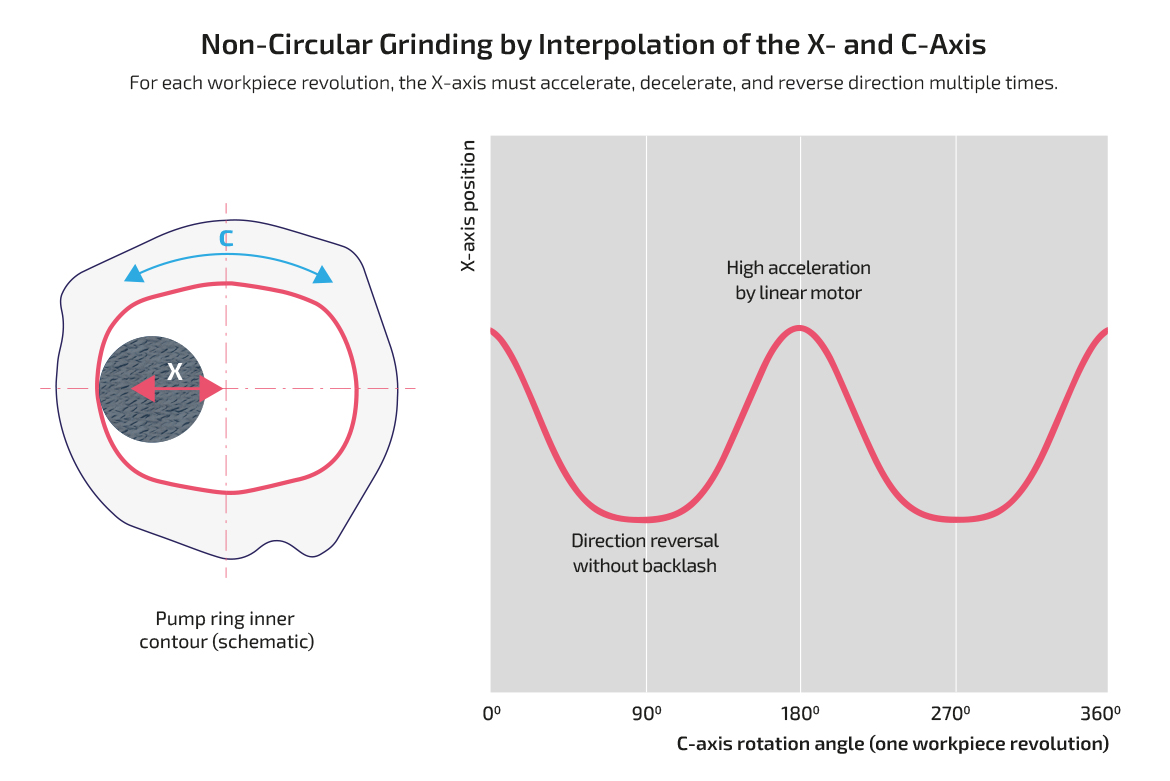
For each rotation of the workpiece, the X-axis accelerates, decelerates, and reverses direction multiple times. The linear motor performs these movements with low-backlash performance and high dynamics.
Two-stage process in a single setup
High chip capacity and a fine surface finish cannot be achieved in a single step, so the process is split between two grinding spindles. Grinding spindle 1 pre-grinds the inner contour using a high-performance, electroplated CBN wheel, removing most of the excess material. Grinding spindle 2 then finishes the part with a ceramic-bonded CBN wheel. Both steps happen in a single setup, eliminating reclamping errors.
The grinding wheels are only 16 mm in diameter, because the smallest contour radius limits the wheel diameter. CBN is the material of choice because its ultra-hard grain wears very little, even with so few grains on the circumference. It also conducts heat better than corundum, keeping the grinding process cool. A low-viscosity oil is recommended as cutting fluids. It prevents hydroplaning in the large contact zone, which would otherwise create high normal forces that deform the slender grinding mandrel.
The initial quality is also important: Since the pump ring is clamped flat, its end faces must first be ground to be plane-parallel. This is the only way to reliably achieve the required perpendicularity.
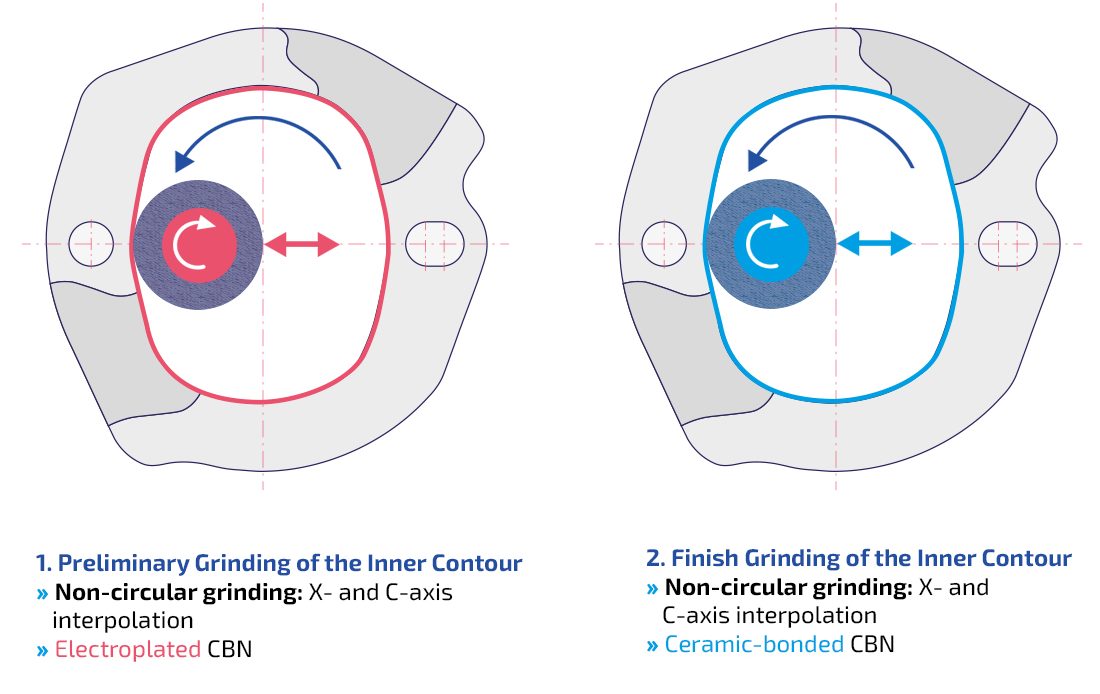
Grinding spindle 1 performs rough grinding with electroplated CBN, while grinding spindle 2 performs finish grinding with ceramic-bonded CBN—in each case via interpolation of the X and C axes.
From the value table to the NC program: EMAG Contour
The EMAG Contour software translates the target geometry from a value table into X- and C-axis path and speed profiles. It accounts for the machine’s dynamic behavior, including acceleration and jerk, so the axes move quickly without overshooting. You can also import measurement data from machined components. The software compares the actual and target contours and calculates axis corrections. The more dynamic the X-axis, the shorter grinding times can be, which is another advantage of the linear motor.
Conclusion: The VL 100 GT combines a low-backlash, highly dynamic linear motor on the X-axis with two grinding spindles for rough and finish grinding in a single setup. Pick-up automation is included, the MINERALIT® bed ensures a smooth process, and with approximately 9.6 m², the footprint remains compact.