Laser Processing in Batch Production – Precision, Efficiency, and Reliability
EMAG offers a wide range of laser processing solutions: from laser welding and laser cleaning to laser metal deposition. These processes deliver top component quality, minimal downtime, and direct integration into existing manufacturing systems.

Three Different Processes: Laser Processing at EMAG
Laser Welding: Weight-Optimized Components without Rework
Laser welding joins precision components with minimal heat input and high reproducibility. In transmission manufacturing especially – when joining the gearwheel and clutch body, for instance – it produces more compact components and low-noise manual transmissions. Because components can be fully machined before welding, time-consuming post-processing is eliminated. EMAG ELC laser welding machines are built on standardized platforms and configure flexibly into component-specific manufacturing systems.
Laser Cleaning: Fast, Low-Maintenance, and Ready for Direct Production Line Integration
Laser cleaning vaporizes contaminants – cutting fluids, oxides, and dirt particles – using high energy and no cleaning agents. The residues are drawn off by an extraction system and neutralized by filter or catalytic systems. The result: a process-reliable, residue-free surface ideally prepared for subsequent processing steps like laser welding. Because the process integrates fully into manufacturing systems, it eliminates lengthy part handling and costly downtime.
Laser Metal Deposition: High-Quality Protective Coatings for the Most Demanding Applications
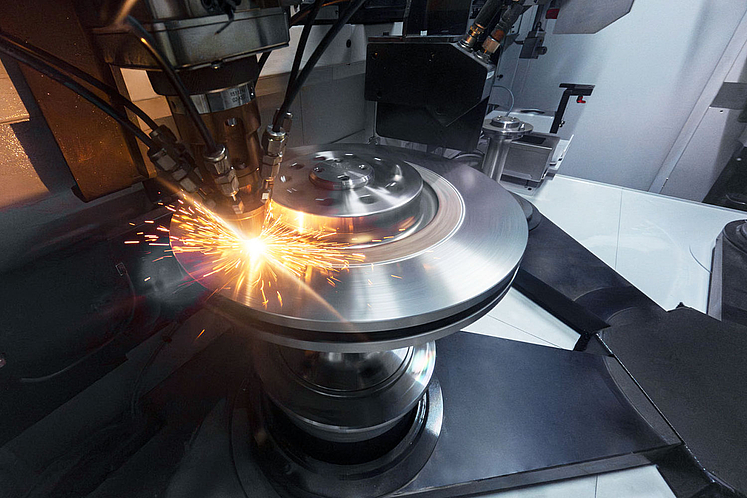
Laser metal deposition (LMD) produces metallurgically bonded protective coatings with defined geometry and high adhesion. A key application is brake disc manufacturing: Pore-free, crack-free carbide coatings can double brake disc service life and reduce brake dust to Euro 7 limits. Single-layer and two-layer systems are available by vehicle class. Powder utilization of up to 95% also keeps the process resource-efficient.
Advantages
- Minimal component warpage: The precisely controllable energy of the laser beam keeps heat input low, for components with minimal warpage and dimensional stability.
- Full process integration: Laser welding, laser cleaning, and laser metal deposition integrate seamlessy into existing production lines – with no part handling and very short cycle times.
- No consumables required for cleaning: Laser cleaning requires no cleaning agents, produces no waste, and is low-maintenance – lowering operating costs and protecting the environment.
- High coating quality: The LMD process produces metallurgically bonded, pore- and crack-free coatings with up to 95% powder utilization – resource-efficient and reproducible.
- New design freedom through laser welding: Joining different materials opens up new component geometries and lighter designs for more efficient vehicles.
- Digitally monitored processes: Process parameters like layer thickness, laser power, and molten pool size can be measured inline – for seamless quality assurance in batch production.
Questions and Answers
- How does laser processing work in general?
- For which components and materials is laser processing suitable?
- Which EMAG laser processing methods are available?
- What does a typical process chain involving laser processing look like?
- Which machines does EMAG use for laser processing?
- What quality and tolerance requirements can be achieved with laser processing?
- What economic advantages does laser processing offer in batch production?
Laser processing uses a high-energy laser beam to join, clean, or coat materials with precision, while minimizing heat input and ensuring high reproducibility. Depending on the process, the laser beam melts material (welding), vaporizes contaminants (cleaning), or melts metal powder onto component surfaces (coating). The precisely controllable energy makes laser processing particularly suitable for precision components in batch production.
Laser processing works with a wide range of metallic materials, including steel, cast iron, stainless steel, and various alloys. Typical components include transmission parts like gearwheels and clutch bodies (laser welding), brake discs (laser metal deposition), plus components that must be cleaned of cutting fluids and oxides before further processing (laser cleaning). The process is especially valuable when tight tolerances must be maintained and warping minimized.
EMAG offers three complementary laser processing methods: laser welding for joining powertrain and chassis components, laser cleaning as a space-saving alternative to conventional parts washers, and laser metal deposition (LMD) for functional protective coatings. All three integrate into standardized manufacturing systems and coordinated with one another.
A proven process chain begins with pre-processing of individual parts, then laser cleaning to leave the joining or coating surfaces residue-free. Next comes either laser welding or laser metal deposition to create wear-resistant surfaces. For coated brake discs, a grinding process follows to bring surface roughness within the required dimensional tolerances. The entire process chain is designed for minimal downtime and inline quality assurance.
For laser welding, EMAG relies on the ELC machine series – built on standardized platforms and configurable for specific components. Laser metal deposition runson machines like the ELC 450 LMD, purpose-built for hard coating brake discs in batch production. The laser cleaning modules are compact and integrate directly into existing manufacturing systems. Contact us – we’ll help you find the right machine configuration for your application.
In laser welding, the low heat input enables low-warpage joints ready for assembly—without rework. In laser metal deposition, layer thicknesses of 100–250 µm are produced with pore- and crack-free quality, and the grinding step that followsbrings surface roughness from 60 µm down to the functionally required 5 µm. Laser cleaning achieves reliable cleanliness with no cleaning agent residues. All process parameters can be monitored and documented inline.
Laser processing reduces total operating costs on multiple levels: Laser cleaning eliminates the need for consumables and waste disposal. In laser metal deposition, powder utilization of up to 95% significantly reduces material loss. Data-driven process integration can cut downstream grinding wheel wear by up to 30%. The result is a much more efficient process chain with shorter cycle times and higher equipment utilization.
Technologies

Technologies
In laser cladding, metallic filler material in powder or wire form is precisely introduced into a molten pool created by the laser. This results in a…
Laser cleaning is a fast and space-saving process that can replace conventional washing machines in many applications. One of its main strengths is…
Laser metal deposition (LMD) is a thermal coating process where metal powder is melted by a laser beam and directly applied to a component. This…
Laser welding is a precondition for compact, weight-optimised components and thus for energy- efficient vehicles. Adjustable doses of concentrated…