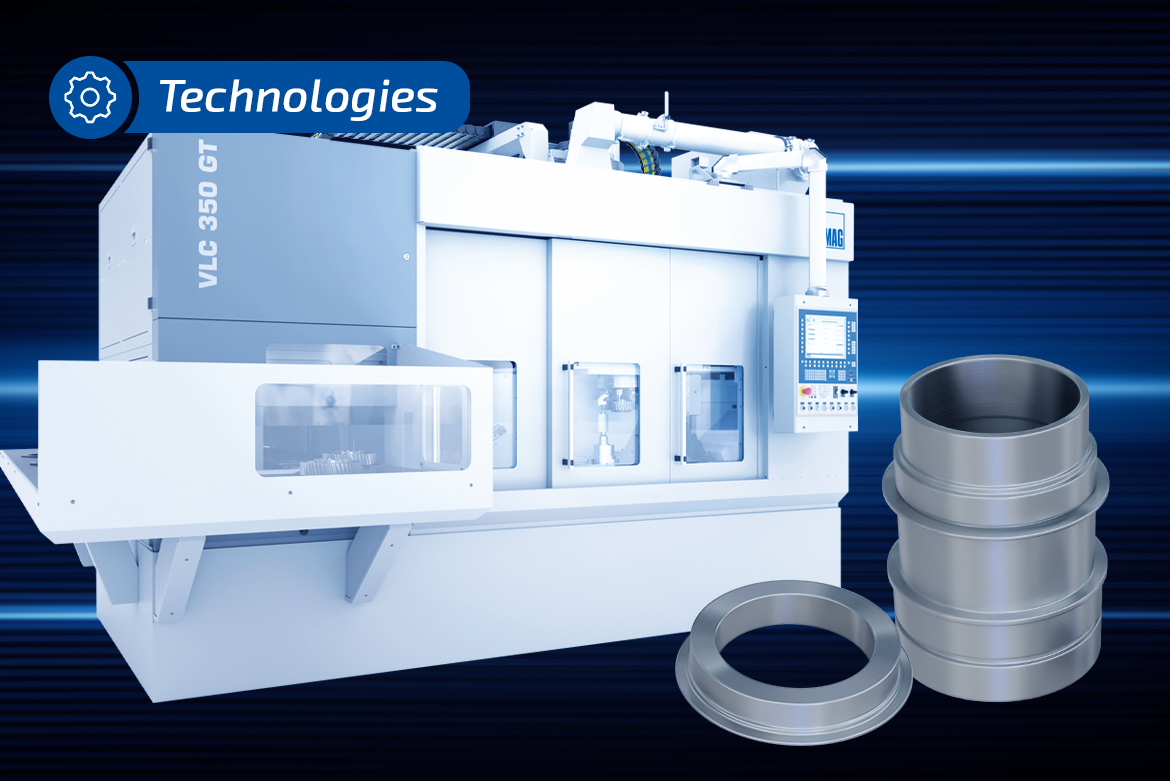
Wave generators are central drive elements in strain wave gears, which are used in robotics in particular due to their high reduction ratios and compact design. The component consists of a ball bearing with an elliptically shaped outer ring, which is mounted on a shaft and typically acts as the input side of the gearbox.
Producing these components presents significant technical challenges for manufacturers: The required shape tolerances in the single-digit micrometre range combined with complex elliptical geometries and thin-walled structures require specialized manufacturing strategies and highly capable machine tools.
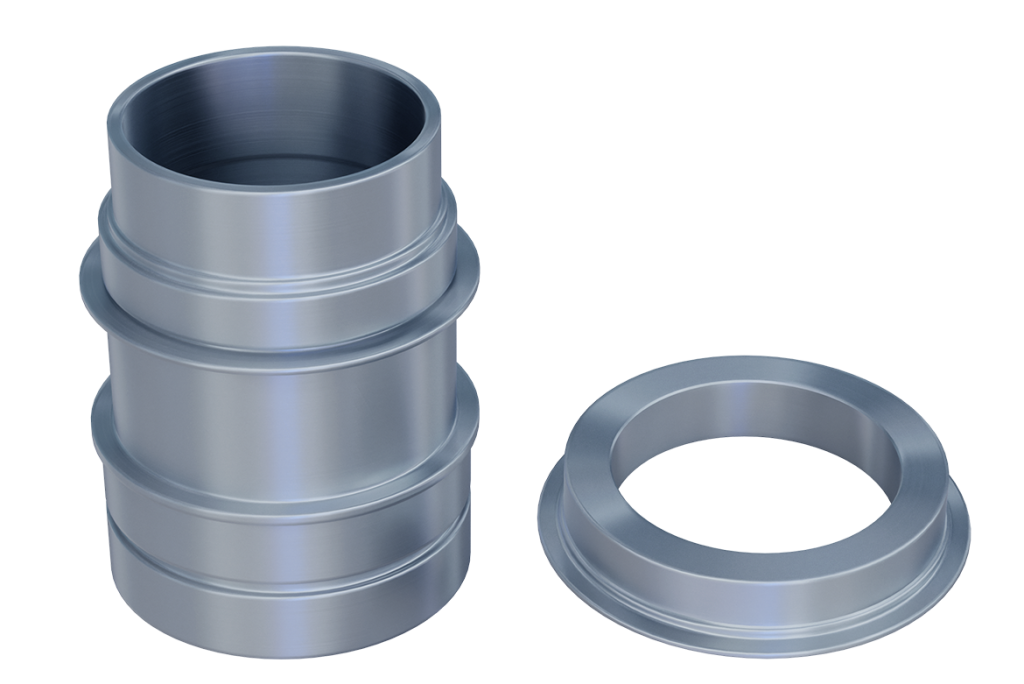
Precision component of a strain wave gearbox. The wave generator transmits the elliptical motion to the flexspline and requires µm-precise machining.
Manufacturing Challenges
The machining of thin-walled, hardened and tempered workpieces with elliptical geometries leads to several challenges:
- Workpiece deformation due to clamping forces Thin-walled structures tend to deform elastically under clamping force. With the required tolerances of 3 μm, even minor clamping force influences lead to dimensional deviations that are outside the specification.
- Process-related heat generation The grinding of tempered materials (HRC 40) generates considerable process heat, which can lead to thermally induced shape deviations.
- Geometric complexity The elliptical shape requires a continuous interpolated path movement between workpiece and tool. Conventional cylindrical grinding processes cannot be used here.
- 4. Process chain dependency With sequential machining in several setups, the reference surfaces (bore/ O/D (Outer Diameter)) and the elliptical contour must be produced in different process steps, resulting in tolerance chains and the required symmetry/concentricity cannot be reliably achieved.
Process Strategy: Complete-Machining in a Single Setup
Basic Principle
The solution to these manufacturing challenges is the complete-machining of all functionally relevant surfaces in a single setup. By integrating turning, milling and grinding operations on one machine tool, the following advantages can be achieved:
- Elimination of reclamping errors and tolerance chains
- Simultaneous production of reference surfaces and functional geometry
- Reduced workpiece-related lead times
- Fewer handling and set-up processes
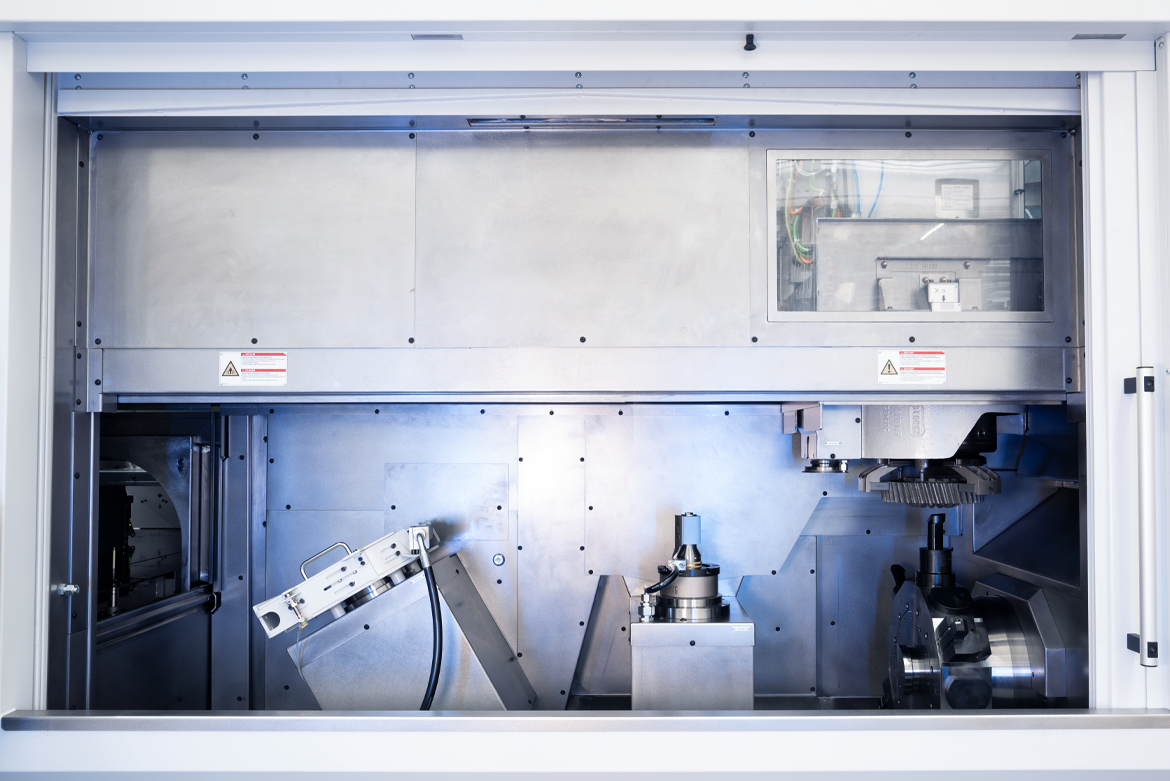
View into the work area of the VLC 350 GT. The machine combines turning, milling and grinding in a single setup and guarantees maximum shape and dimensional accuracy for complex workpieces.
Machine Concept: VLC 350 GT
The VLC 350 GT is designed as a vertical turning and grinding machine with the following configuration:
Technical Equipment:
- Vertically arranged main spindle (workpiece spindle): Ø400 mm chuck, swivel diameter 420 mm
- Turret with integrated turning tools and driven tools
- Internal grinding spindle (B-axis): Speed range 26,000-75,000 min-¹
- External grinding spindle: grinding wheel Ø400 mm, 7,200 min-¹
- Dressing spindle for automatic grinding wheel conditioning
- X-axis with linear motor: 2,390 mm stroke, rapid traverse speed 120 m/min
- Z-axis: 350 mm stroke, rapid traverse speed 30 m/min
Process-Relevant Features:
The linear direct drive in the X-axis enables highly dynamic positioning movements without mechanical backlash. This is crucial for elliptical machining, as the continuous interpolation movement requires high accelerations and changes of direction. Due to the backlash, conventional ball screws exhibit path deviations that are unacceptable with the required tolerances.
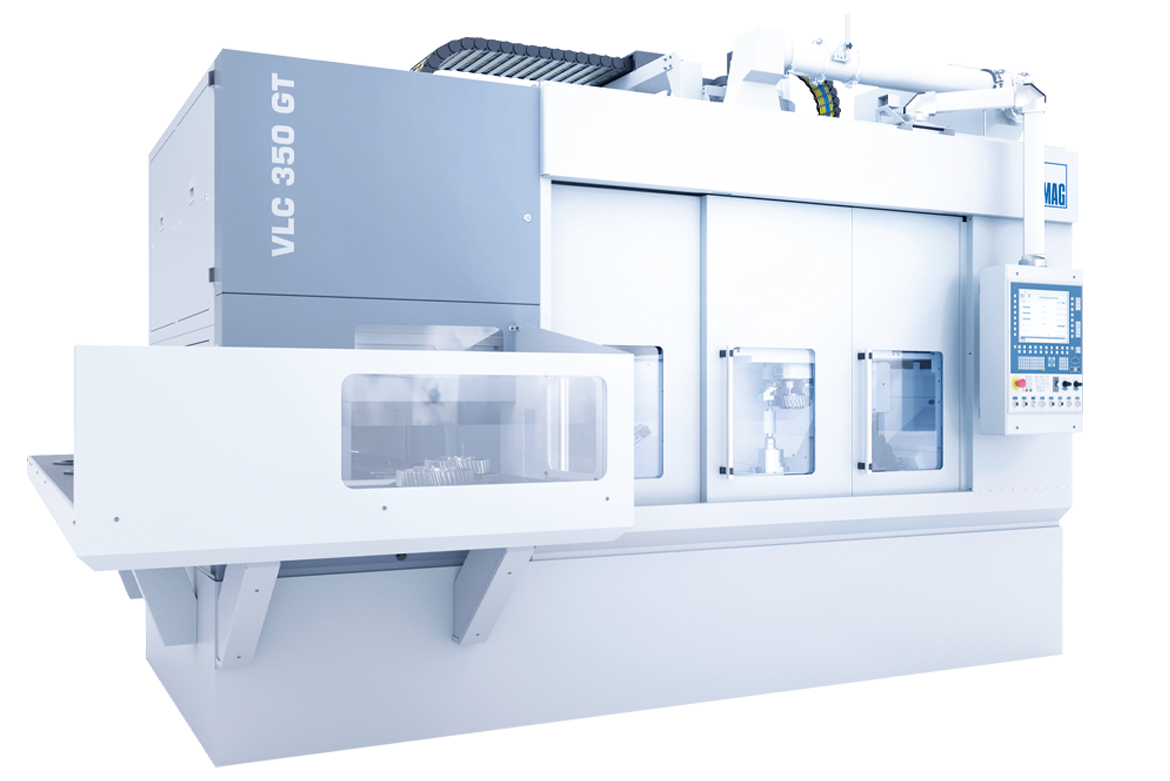
The VLC 350 GT combines turning, milling and grinding in one machine. Its vertical pick-up concept enables complete-machining in a single setup with maximum precision.
The Advantages of Machining in a Single Setup
The production of wave generators for harmonic reducers places high demands on production technology due to tight tolerances, complex geometries and thin-walled structures. Complete-machining on the VLC 350 GT by integrating turning, milling and grinding operations in a single setup offers the following advantages:
Technical:
- Reliable adherence to tolerances in the range of 3-5 μm
- Elimination of tolerance chains through simultaneous reference and contour machining
- High-precision ellipse machining thanks to linear motor-controlled NC interpolation
- Integrated workpiece handling and autonomy thanks to pick-up spindle and O-belt automation
- Modular robot cells available
Economical:
- Reduction of cycle times by combining machining processes
- Minimization of lead times and capital commitment
- Reduction of quality costs through process reliability
Strategic:
- Flexible adaptation to product variants
- Scalability for different component sizes
- Future-proof technology for growing requirements in robotics