Machining of Wave Generator Components on the VLC 350 GT

The wave generator is the input component in the strain wave gear. It consists of a thin-walled bearing structure (outer ring elastic, inner ring fixed on an elliptical cam) and defines the positive deformation of the flex-wheel via its elliptical contour. Accordingly, shape and position tolerances in the µm range are required; typical drawings require, among other things, concentricity/symmetry of the elliptical curve to the reference bore or reference O/D (Outer Diameter) as well as profile tolerances ≤ 3 µm - to be produced in one setup in order to avoid reference errors.

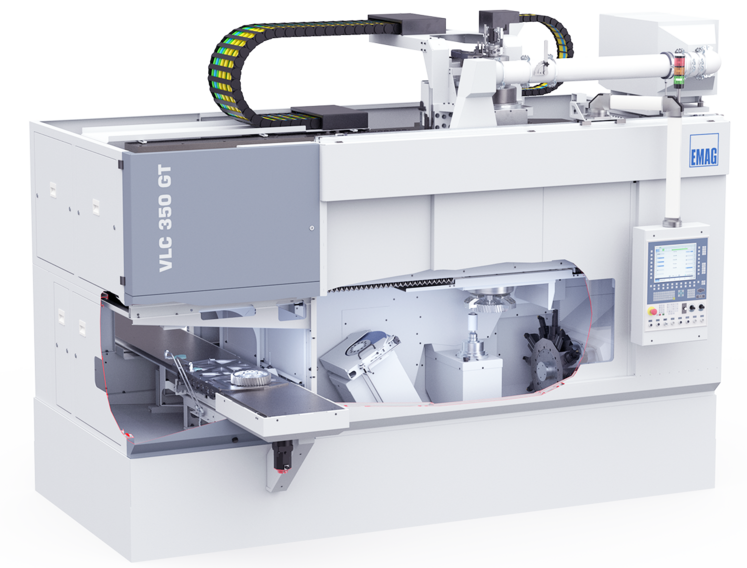
VLC 350 GT complete machining center with external grinding spindle, internal grinding spindle and turret for wave generator production in harmonic reducers
Vertical turning and grinding machine VLC 350 GT from EMAG for high-precision complete-machining of wave generators in harmonic reducers.

Role of the Wave Generator and Quality Requirements

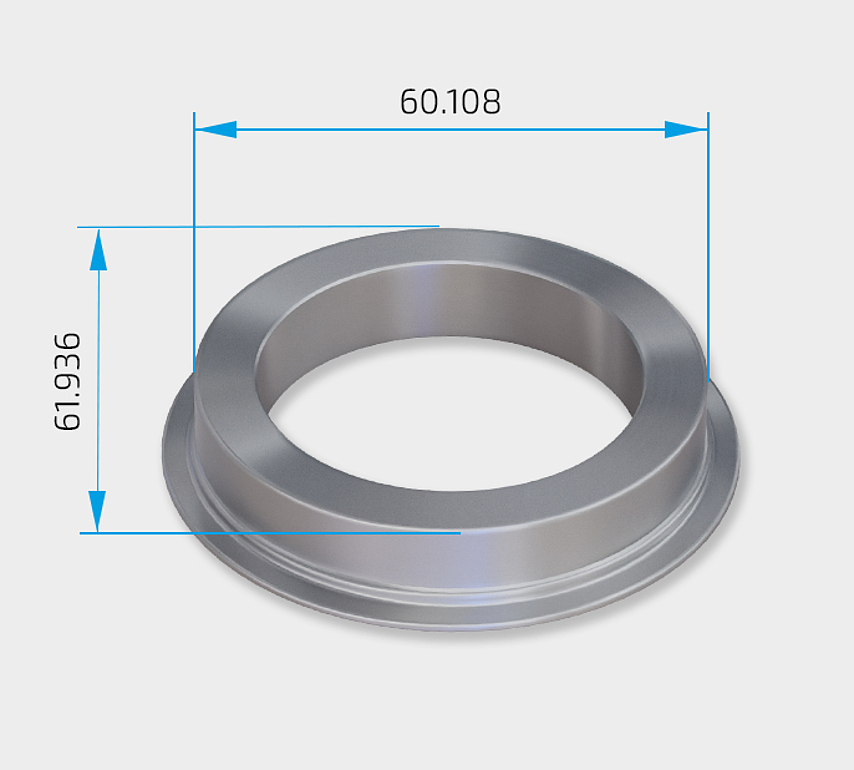
Wave generator machining with elliptical internal geometry on the VLC 350 GT
Wave generator with elliptical internal geometry - high-precision machining on the VLC 350 GT. The µm-precise inner contour is crucial for the function of the strain wave gear.

Case Study 1: Wave Generator with Internal Geometry

Clamping Situation:

The workpiece is clamped via the external contours and end face. The functionally relevant areas - inner bore, lower end face and ellipse - are located below the clamping plane, which minimizes the influence of the clamping forces on the machining zone. 

Process Sequence:

1. Turning of the reference surfaces:

  • Face turning of the end face (reference plane)
  • Internal turning of the bore Ø48 with minimum allowance for subsequent internal grinding
  • Pre-turning of the ellipse contour to minimum diameter

2. Pre-milling of the ellipse:

  • Pre-milling of the ellipse shape with minimum stock allowance
  • Advantage: Significant reduction in grinding time compared to grinding alone

3. Internal grinding:

  • Finish grinding of the Ø48 mm bore to final dimension
  • In-process measurement for diameter control

4. External grinding of the ellipse:

  • Finish grinding of the ellipse contour
  • Continuous NC interpolation with linear motor X-axis
  • Sparking to minimize residual stresses

Critical Process Parameters:

Grinding tempered materials at HRC 40 requires adapted cutting parameters. Excessively high infeed rates lead to thermal damage (grinding burn) and residual stresses. The process strategy therefore provides for several roughing infeeds followed by finishing infeeds and final sparking.


Case Study 2: Wave Generator with External Geometry

Clamping Situation:

In this variant with a solid shaft, the workpiece fixture poses a particular challenge. The component is held using a face chuck. Axial fixing is achieved via contact cones on the end face.

This clamping method ensures that:

  1. No radial clamping forces act on the outer surfaces to be machined
  2. The axial clamping force is applied in a defined manner

Process Sequence, CBN Grinding Technology:

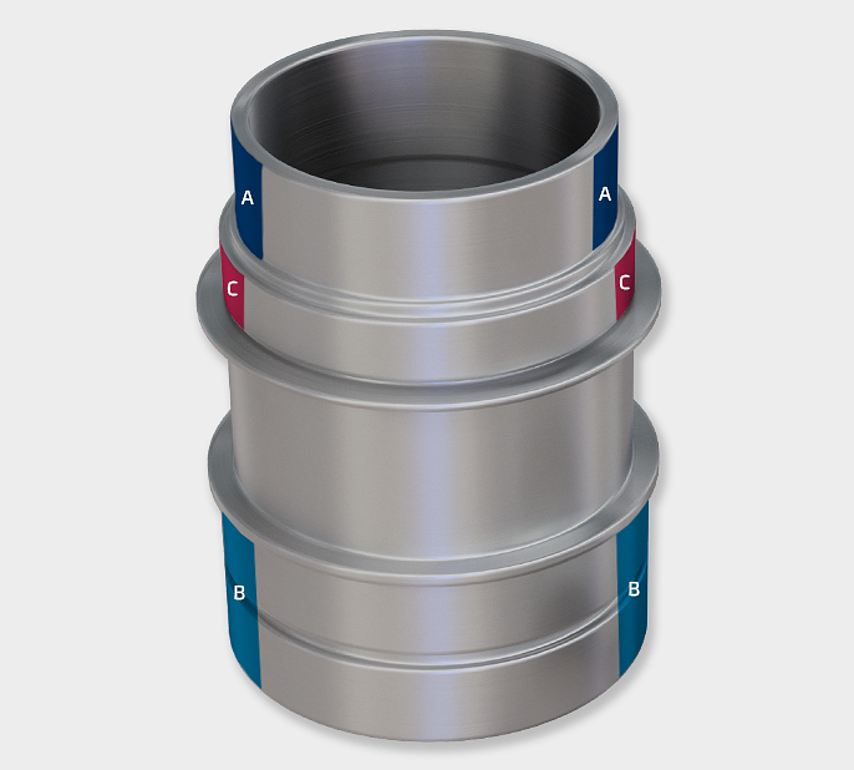
Elliptical external contours of a wave generator component
Wave generator profile with elliptical external contours. The shape deviation is in the µm range and requires high-precision grinding.

1. External grinding Reference A:

  • Grinding the O/D (Outer Diameter) 53 mm
  • Diameter check using a measuring probe

2. External grinding Reference B:

  • Grinding the O/D (Outer Diameter) 63 mm
  • Concentricity measurement for reference A

3. Ellipse grinding (C)

  • Final grinding of the ellipse contour with continuous NC interpolation
  • Symmetry check to the reference diameters A and B

Customer Benefits 

  • Process-reliable tolerance compliance: The production of reference surfaces and elliptical contours in a single setup eliminates sources of error from workpiece circulation and reclamping. The required tolerances of 3 μm for concentricity and symmetry are achieved with process reliability.
  • Reproducibility: CNC-controlled elliptical machining with a highly dynamic linear motor ensures consistent contour quality across the entire batches.
  • Cycle time savings: The combination of pre-milling and finish grinding of the ellipse reduces the machining time by 30-40% compared to grinding alone. Pre-turning and subsequent rough-machining using a milling tool removes material much more efficiently than grinding.
  • Reduction in lead times: By eliminating re-clamping and transport operations between different machines, workpiece-related lead times are reduced significantly.
  • Set-up time minimization: The one-time workpiece pick-up and automatic tool changes during machining minimize manual intervention. This not only reduces set-up times, but also the potential for errors due to manual handling processes.

(1) 款机床已找到

VLC 350 GT

Customized
  • 工件最大直径: 350 mm | 14 in
  • 工件最大长度: 200 mm | 8 in
  • 最大卡盘直径: 400 mm | 15.5 in